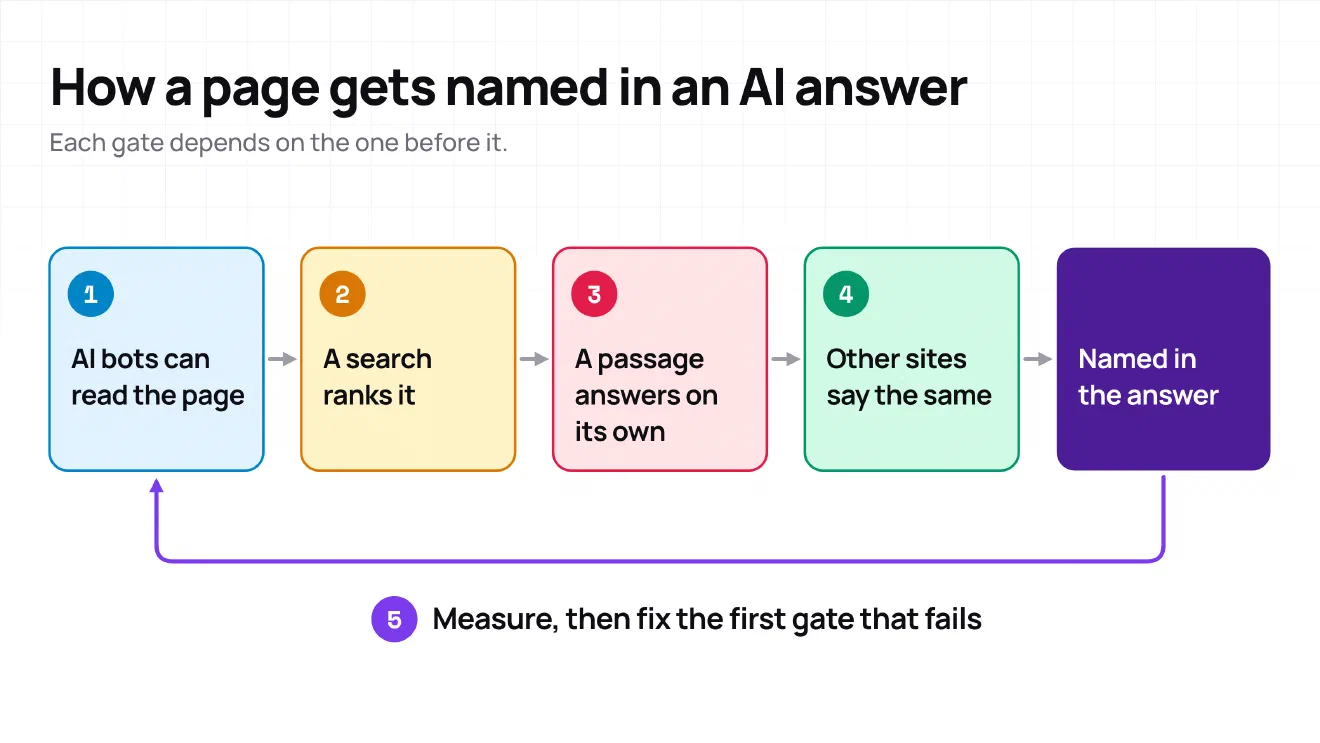
A freelance illustrator in Leeds asks ChatGPT for the best invoicing app for a UK freelancer. The answer names 4 apps, and yours is not one of them. There is no position 1 to climb to here. Your “AI rank” is the share of answers like that one that name you, and it goes up when 5 things are true, in this order: the AI app’s bots can read your pages, the search index it uses ranks them, a passage on them answers the question on its own, other sites repeat your claims, and you measure the result over many runs. Each step depends on the one before it, so work on step 4 does nothing while step 1 is broken.
In short
- AI rank is a share, not a position. It is how often each AI app names you across many runs of the questions your buyers ask.
- Let the AI search bots in, and serve plain HTML. Blocking OAI-SearchBot removes you from ChatGPT’s search answers, and most AI crawlers never run JavaScript.
- Rank for the narrow searches the AI runs, in Bing as well as Google. Only 12% of the pages AI apps cite rank in Google’s top 10 for the question the user typed.
- Write passages that make sense on their own, then get other sites to repeat them. In Ahrefs’ data on AI Overviews, brand mentions track visibility 3 times as closely as backlinks.
- Measure per app, over weeks. The same question almost never gives the same list of brands twice.
What your AI rank actually is #
Classic SEO gave you a number. You ranked 3rd for “invoicing app uk”, and you could watch it move. AI answers do not work like that. Each answer gets written fresh, from whatever pages the app found that time, and the list of brands changes from 1 run to the next. When SparkToro and Gumshoe had 600 volunteers run the same 12 prompts 2,961 times, they found less than a 1 in 100 chance that ChatGPT or Google’s AI would give the same list of brands in any 2 answers.
So the useful number is a share. To keep 1 example running through this post, say you market Acme Invoice, a made-up UK invoicing app for freelancers. Ask the illustrator’s question 50 times and count how often Acme Invoice appears. If it shows up in 10 of the 50 answers, its AI rank on that question is 20%. Do the same on each app and for the 20 or 30 questions your buyers ask, and you have a number you can move.
What moves it follows from how the answer gets built. I went through the mechanics in how ChatGPT and Gemini choose brands, so here is the short version. The app turns the question into several searches -> a search index returns candidate pages -> the app’s bot opens a few of them -> the model reads passages -> it writes the answer, leaning on claims that several sources agree on. Each of the 5 steps below gets your page through one part of that chain. The order matters, because a page that fails early never reaches the later parts.
Step 1: let the AI search bots read your pages #
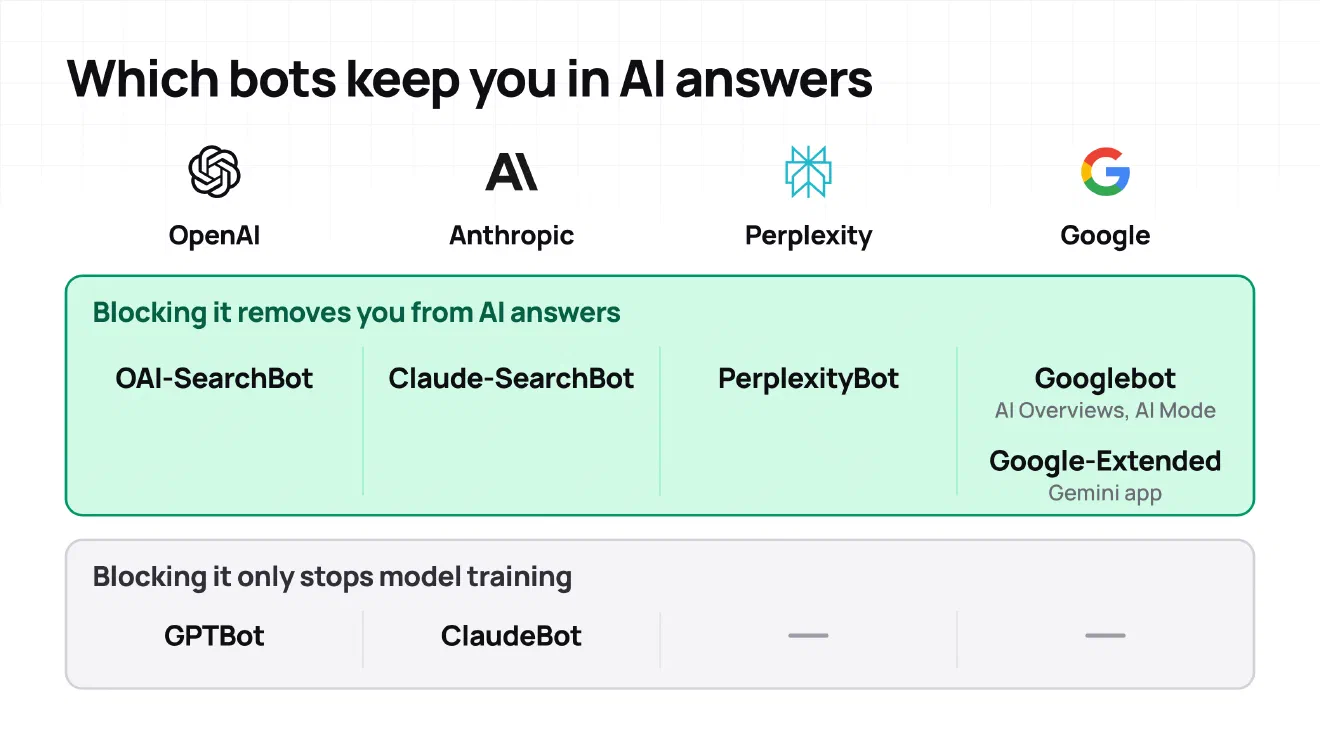
Every big AI company runs more than one crawler, and they do different jobs. That matters, because a lot of sites block “AI bots” as a group and take themselves out of the answers by accident.
OpenAI is the clearest example. GPTBot collects pages to train future models. OAI-SearchBot crawls pages so ChatGPT can show them in search answers. ChatGPT-User fetches a page live when someone’s question needs it. The settings are independent, and OpenAI’s bot documentation is blunt about the search one: “Sites that are opted out of OAI-SearchBot will not be shown in ChatGPT search answers.” Anthropic splits its bots the same way, with ClaudeBot for training and Claude-SearchBot for search. Perplexity’s PerplexityBot builds its search results and, Perplexity says, is not used for training at all.
Google is the odd one out. AI Overviews and AI Mode draw on the ordinary Google index, so Googlebot is the crawler that decides whether you can appear. Google says a page needs to be indexed and eligible for a snippet, and that “there are no additional technical requirements”. The separate Google-Extended token does not affect Search at all. It does decide whether Gemini models train on your pages and whether the Gemini app can use them to ground its answers, according to Google’s crawler docs. So blocking Google-Extended keeps you in AI Overviews but costs you in the Gemini app.
Google added 1 more switch this summer. Since 31 August 2026, every site in Search Console has a Search generative AI setting under Settings, which can exclude the whole site from AI Overviews and AI Mode. It defaults to Include. Check that nobody on your team has changed it.
If you want your pages kept out of training but left in the answers, robots.txt can say exactly that:
# Stay in AI search answers
User-agent: OAI-SearchBot
User-agent: Claude-SearchBot
User-agent: PerplexityBot
Allow: /

# Keep pages out of model training
User-agent: GPTBot
User-agent: ClaudeBot
Disallow: /
The fetchers that run when a person asks are a separate case. OpenAI says robots.txt rules “may not apply” to ChatGPT-User, and Perplexity says Perplexity-User “generally ignores” them, since a person asked for the page.
Your CDN can block bots before robots.txt even comes into it, and Cloudflare changed its rules again on 15 September 2026. Its “Block” setting for training bots now also stops Googlebot, Bingbot and Applebot, because those crawlers feed search and training at once. Choose Block there and you drop out of Google and Bing, and so out of AI Overviews, AI Mode and Copilot as well. The new “Disallow AI Training” setting is the one that keeps search open, and Cloudflare moved existing training blocks over to it. Cloudflare also says fewer than 1% of its sites block search bots, so you are probably fine. Still, check the setting before someone tidies up the bot rules.
The more common problem is JavaScript. When Vercel and MERJ studied AI crawler traffic across Vercel’s network, they found that “none of the major AI crawlers currently render JavaScript”. GPTBot and Claude’s crawler download script files and never run them. Google is the exception, because Googlebot renders pages for Search and Gemini reads from the same index.
Now picture Acme Invoice’s pricing page. It is a React app, and the plan table, with “Free for 3 clients, then £8 a month”, appears only after the scripts run. A browser shows the price. OAI-SearchBot gets an empty shell with a loading spinner. When the model looks for what Acme Invoice costs, there is nothing on the page for it to read.
You can check your own pages in a minute. Fetch the page the way these crawlers do, with no JavaScript, and look for the sentence that matters:
curl -s https://www.acmeinvoice.example/pricing | grep -c "£8"
A 0 means the price only exists after JavaScript runs. Fix it with server-side rendering or static HTML for the pages that carry your key facts: pricing, features, comparisons and help docs.
Step 2: rank for the searches the AI runs #
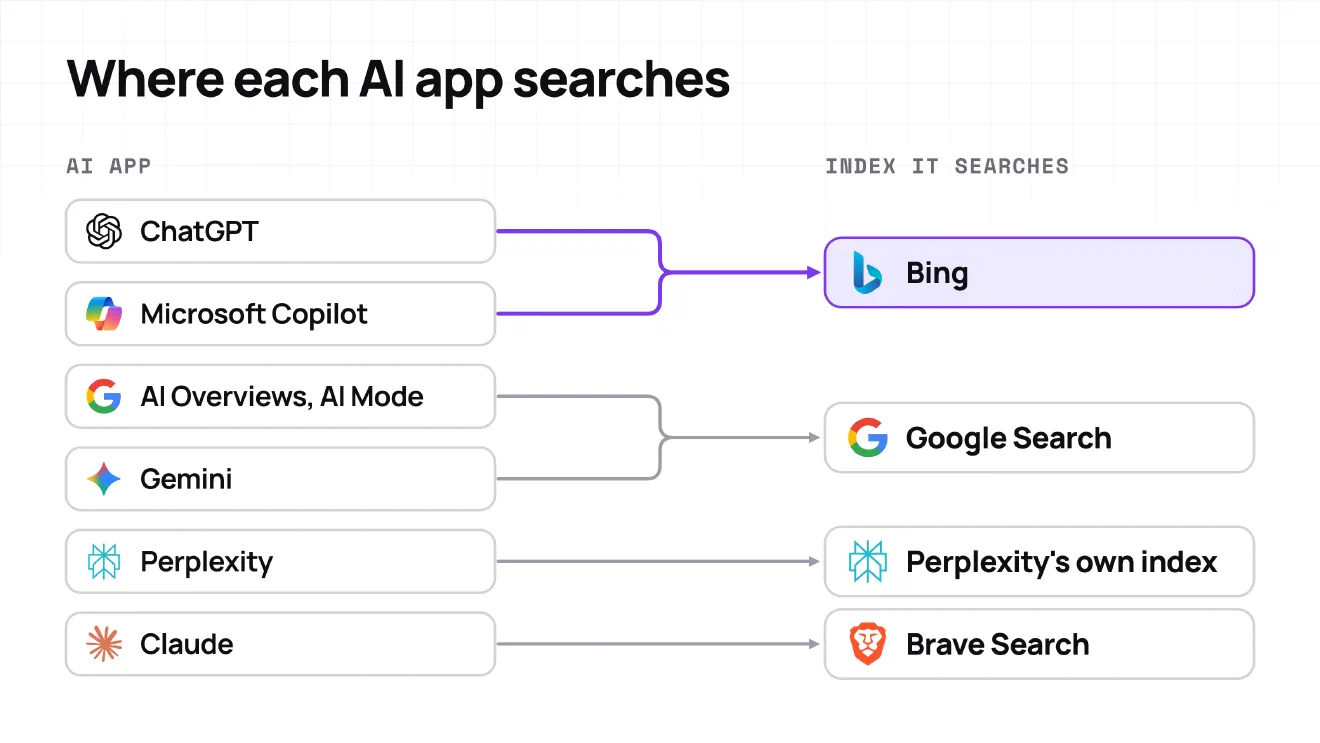
Once a bot can read the page, the page still has to turn up in a search. For a question like the illustrator’s, the apps search the web, and they do not all search the same index:
- ChatGPT uses outside search providers, and OpenAI’s help centre names Bing among them.
- Microsoft Copilot runs on Bing.
- AI Overviews, AI Mode and Gemini use Google’s index.
- Perplexity runs its own index, built by PerplexityBot.
- Claude’s web search runs at least partly on Brave, which Anthropic added to its list of subprocessors in March 2025.
So a site that Bing does not rank loses ChatGPT and Copilot at the same time. In my experience, plenty of teams have never opened Bing Webmaster Tools. Verify the site there, submit the sitemap, and turn on IndexNow, which tells Bing about a changed page straight away. Yandex, Seznam, Naver and Yep take the same ping. Google does not.
Then comes the part that surprises people. The apps do not search for the question the buyer typed. They break it into narrower searches, which Google calls query fan-out: “issuing multiple related searches across subtopics and data sources”. For the illustrator’s question, the searches might look like this:
- invoicing app for freelancers UK
- Making Tax Digital software for sole traders
- FreeAgent vs Xero for freelancers
- free invoice app UK VAT
That is why ranking for the head term matters less then you would expect. When Ahrefs checked 15,000 long-tail prompts across several AI assistants, only 12% of the cited pages ranked in Google’s top 10 for the prompt itself. For ChatGPT it was 8%. Google’s own AI Overviews have moved the same way. In July 2025, Ahrefs found 76% of the pages they cited ranked in the top 10 for the search. By March 2026 it put the figure at about 38%, with a new counting method and Gemini 3 now behind AI Overviews, so the 2 numbers are not a clean comparison. The direction is clear enough.
The pages that get cited rank for the narrow searches. Acme Invoice will struggle to outrank FreeAgent for “invoicing app for freelancers UK”. But sole traders with more than £50,000 of qualifying income have had to use Making Tax Digital for Income Tax since 6 April 2026, and a clear page on how Acme Invoice handles those quarterly updates has a real shot at the Making Tax Digital search.
You do not have to guess what the narrow searches are. Bing Webmaster Tools has had an AI Performance report in preview since February 2026. Its grounding queries view shows “the key phrases the AI used when retrieving content” from your site for Copilot and Bing’s AI answers. Google Search Console added generative AI performance reports in June 2026, with impressions per page in AI Overviews and AI Mode.
One warning. Do not write a separate page for every sub-query you can think of. Google’s guide to generative AI search says that doing so to manipulate its answers “violates Google’s scaled content abuse spam policy”. 1 good page per real buyer question is enough.
Step 3: write passages that make sense on their own #
Getting opened is not the same as getting quoted. The model does not read your page top to bottom. It reads passages, keeps the ones that answer the search in front of it, and moves on.
Where the answer sits matters. Kevin Indig looked at 18,012 ChatGPT citations and found 44% of them came from the first 30% of the page. So put the answer near the top, and explain after it.
What the passage says matters more. The best evidence here is still the GEO paper from Princeton and others, presented at KDD 2024. The researchers rewrote pages in different ways and measured how much of each page made it into generated answers. Adding quotations lifted visibility by about 41%, and adding statistics by about 31%. Citing sources helped too. Keyword stuffing made things about 8% worse. The tests ran mostly on a simulated engine built on GPT-3.5, so treat the exact numbers loosely. Microsoft’s advice for Copilot points the same way. It asks for “sentences that make sense even when pulled out of context”.
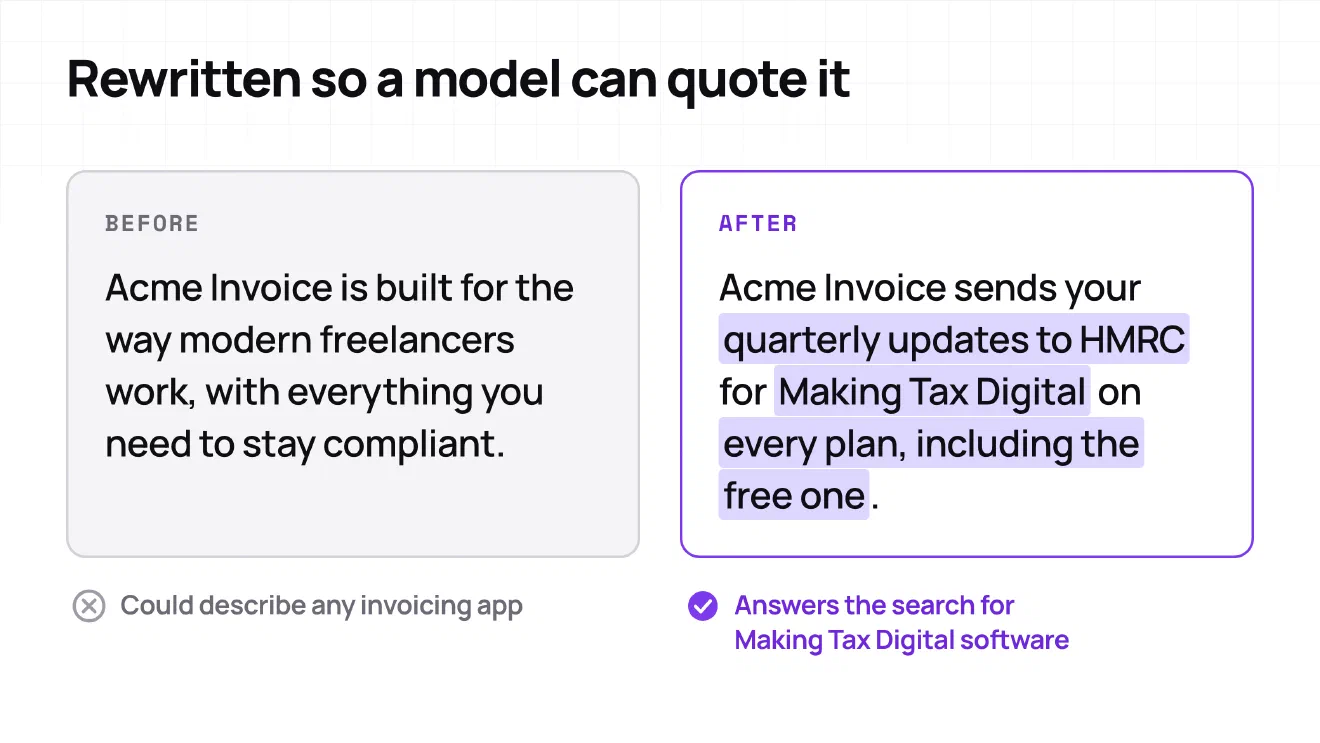
Here is a line from Acme Invoice’s feature page, before the rewrite:
Acme Invoice is built for the way modern freelancers work, with everything you need to stay compliant.
And after:
Acme Invoice sends your quarterly updates to HMRC for Making Tax Digital on every plan, including the free one.
The first version could describe any invoicing app on the market. The second names the product, the rule and the plan, so a model can lift it into an answer about Making Tax Digital without reading anything else on the page.
Google, for its part, says you do not need to break pages into “tiny pieces” or write in a special way for its AI features. I agree, and nothing here asks you to split a page up. Leading with the answer and making each claim specific enough to check is ordinary good editing, and it helps human readers just as much.
Dates help as well. Ahrefs compared about 17 million cited URLs with ordinary search results and found that AI assistants cite content that is 25.7% fresher on average. ChatGPT leaned hardest that way, with cited pages 458 days newer than the organic results. Put a real “last updated” date on pages whose facts change, and update the page when they do.
Step 4: get your claims onto pages you do not own #
Your own page tells the model what you claim. Other pages tell it whether anyone agrees, and the data says that second kind carries a lot of weight.
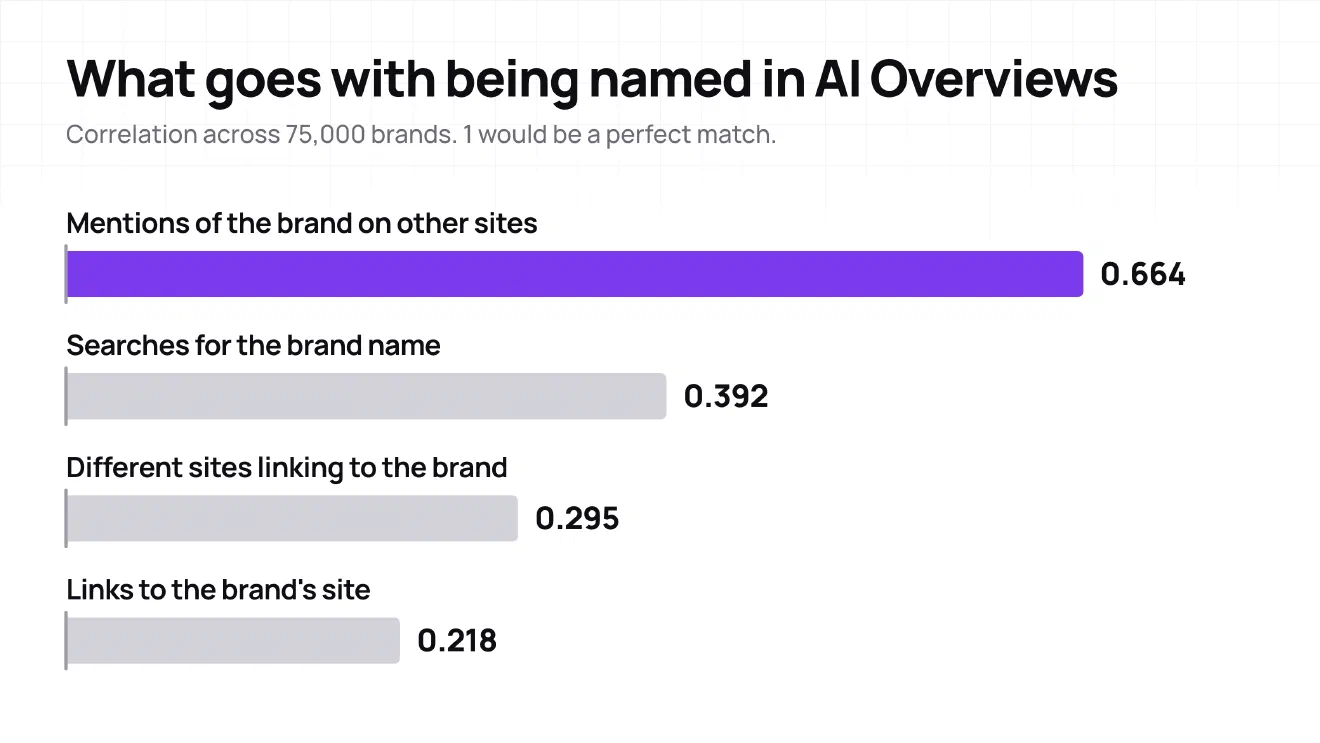
Ahrefs looked at 75,000 brands and asked which signals went with being named in Google’s AI Overviews. Mentions of the brand across the web correlated at 0.664. Backlinks correlated at 0.218. A follow-up in December 2025 added ChatGPT and AI Mode, and found that mentions on YouTube correlated most strongly of all, at about 0.74. These are correlations, and big brands get mentioned more for reasons of thier own. But the pattern holds across all 3 apps, and it fits how Google has described AI Overviews: built to “only show information that is backed up by top web results”.
Which pages count? For “best app” questions, mostly lists. When Ahrefs traced the sources behind 750 ChatGPT prompts, “best X” blog lists made up 43.8% of the pages cited. Press counts as well. Muck Rack’s May 2026 study of more than 25 million AI citations found 84% came from earned media and 0.3% from paid or advertorial content. And the favourite sources move around. Semrush watched ChatGPT cite Reddit in close to 60% of answers in early August 2025, and in around 10% by mid-September.
For Acme Invoice, that becomes a list of jobs. Run each of the narrow searches from step 2 and open the “best invoicing apps for UK freelancers” lists that come up. Is Acme Invoice on them? Is the price current? Does the entry mention Making Tax Digital, or does it describe last year’s product? Then email the authors with the specific facts. Get a short review onto YouTube. Answer the questions freelancers actually ask on Reddit, under your own name. The aim is for the same specific claim, Making Tax Digital on every plan including the free one, to show up on pages Acme Invoice does not control.
Keep it real. Google’s guide lists “pursuing inauthentic mentions” among the tactics to ignore, and fake reviews or planted forum posts tend to get found out by the people you are trying to win over, too.
Ahrefs also found that in 67.6% of “best X software” lists ranking on Google, the author put itself first. You can write your own list, and plenty of vendors do. I would spend the time on other people’s lists first. My guess is that a list on your own domain counts for less, though as far as I know nobody has measured it.
Step 5: measure a share of answers, per app, over weeks #
The last step tells you whether the other 4 worked. It is also the one most teams do badly, because they check AI answers the way they checked rankings: once, by hand, on 1 app.
A single check tells you almost nothing. The SparkToro study found that asking the same question twice rarely gives the same list. It also found something more useful: how often a brand appears across many runs holds steady enough to track. For 1 of their prompts, a brand called Smartsites showed up in 85 of 95 Google AI answers. Rand Fishkin’s conclusion was that “measuring that percent visibility is (probably) a reasonable way to know how prominent or invisible your entity is.”
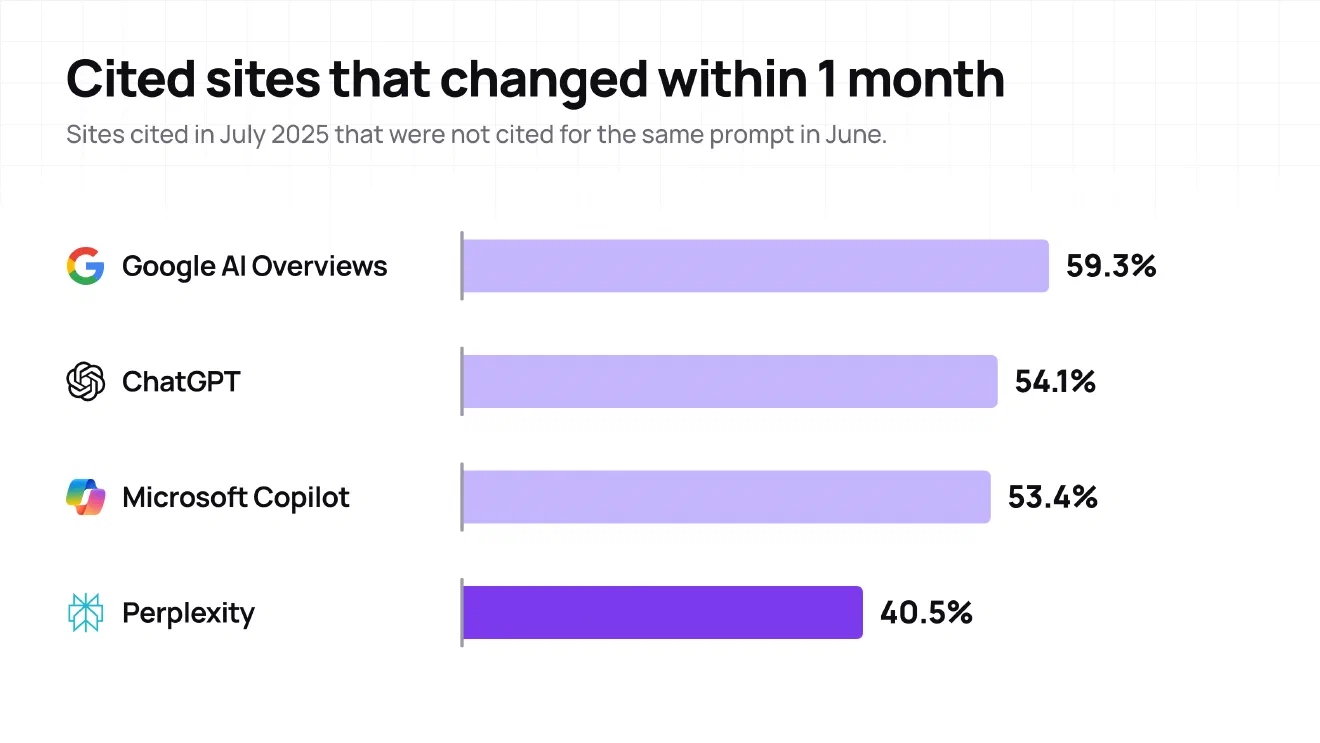
The sources shift under you too. Profound compared about 80,000 prompts per app a month apart, in June and July 2025, and found that 40% to 60% of the cited domains had changed.
So a sensible setup for Acme Invoice looks like this:
- Pick 20 to 30 questions a freelancer would ask, from “best invoicing app UK” to “does FreeAgent do Making Tax Digital” to “Acme Invoice vs Xero”.
- Run each question daily, or at least a few times a week, on every app your buyers use.
- For each app, record the share of answers that name Acme Invoice, where it sits in the list, and which domains got cited.
- Compare week with week, not day with day.
The cited domains are the part people skip, and they are your to-do list for step 4. If the same 3 list articles appear under half your questions, those 3 articles matter more to your AI rank than anything on your own site.
Then look at what the visibility is worth. ChatGPT adds utm_source=chatgpt.com to the links it sends. GA4 has had an AI Assistant channel since May 2026 that groups visits from ChatGPT, Gemini, Copilot and others. It leaves out AI Overviews and AI Mode, which show up in Search Console instead. Expect the traffic to look small next to the visibility. Pew found that people clicked a link inside an AI Overview on about 1% of visits. Being named is the point, even when nobody clicks.
Why this is worth the effort now #
ChatGPT alone has more than 1 billion weekly users, OpenAI said in August 2026. Similarweb counted an average of 770.7 million referral visits a month from AI platforms between June 2025 and May 2026, more than double the year before. And on Google itself, the same Pew study found that people clicked an ordinary result on 8% of visits when an AI summary appeared, against 15% when none did.
Put together, more of the shortlist gets made inside the answer, before anyone reaches a website. The illustrator in Leeds may never search for “invoicing app” on Google at all. If ChatGPT names 4 apps, those 4 are the ones they compare.
The good news is that most of the 5 steps are cheap. Steps 1 and 2 take an afternoon with a developer and 2 webmaster tools. Step 3 is editing. Only step 4 takes months, and step 5 is what tells you it was worth it.
What you can skip #
A few popular fixes have little behind them.
- An llms.txt file. Google’s John Mueller wrote in June 2025 that “no AI system currently uses llms.txt”, and SE Ranking found no link between having the file and being cited across 300,000 domains. Adding one does no harm, but do not expect it to change anything.
- Schema markup as a way into AI answers. Keep it for rich results in Google. But when Ahrefs tracked 1,885 pages that added schema against 4,000 that did not, citations did not rise on any AI platform. Google says there is “no special schema.org structured data that you need to add”. Microsoft does say schema helps its systems understand a page, so it may matter a little more for Copilot.
- A page for every sub-query. Step 2 covers why: Google treats it as spam.
What to do this week #
If you have a week, work through the steps in order and stop at the first one that fails.
- Open your
robots.txt, your CDN’s bot settings and the Search generative AI setting in Search Console. Make sure OAI-SearchBot, Claude-SearchBot, PerplexityBot and Googlebot can reach your pages, and that Google still includes your site. - Run the
curlcheck on your pricing page and your main feature pages. Any key fact missing from the raw HTML needs server-side rendering. - Verify the site in Bing Webmaster Tools and turn on IndexNow. Once data arrives, read the grounding queries in the AI Performance report.
- Rewrite the opening lines of your 5 most important pages so each one names your product and makes 1 specific claim, with a number, a date or a named feature.
- Write down 20 questions your buyers ask, and run each one 5 times in ChatGPT, Gemini and Google’s AI Mode. Count how often you are named, and list the domains that get cited.
The 5th item is the baseline that everything else gets measured against. Running 20 questions 5 times on 3 apps means reading 20 x 5 x 3 = 300 answers, which takes a long afternoon by hand. Lumirank runs this kind of prompt set daily across 6 AI apps, and its free plan covers 10 prompts on 2 of them. I would still do the manual version once. Reading the answers yourself shows you which list articles and which rivals keep coming up, and that is where the the work on step 4 starts.