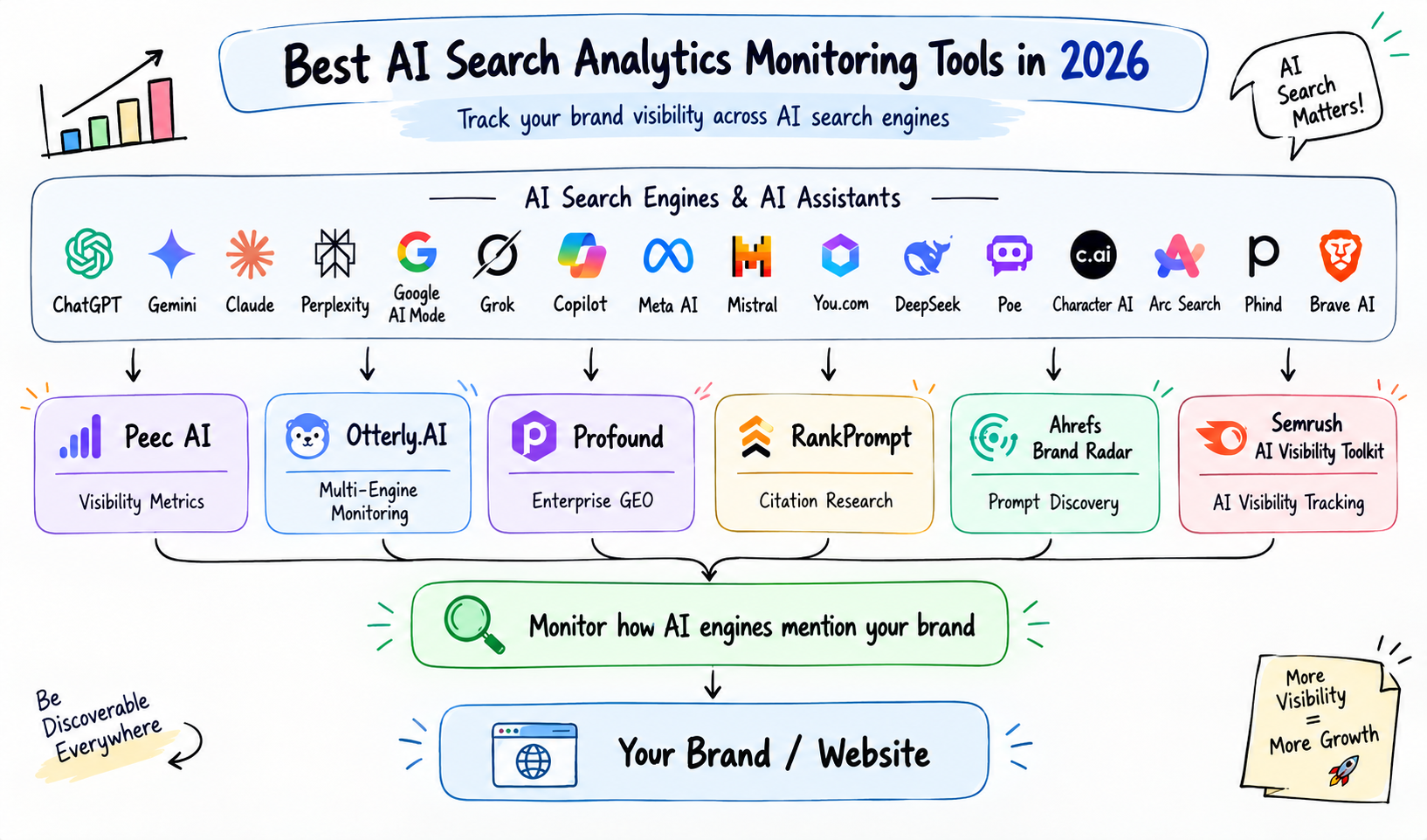
ChatGPT, Gemini, Perplexity and Google’s AI Overviews now shape a buying decision before anyone opens a search results page, and a brand can hold the top Google ranking for its category while an AI model never names it once. Watching that gap needs its own loop, not a tab bolted onto a rank tracker built for a different job.
Every tool below measures some mix of the same four things: whether you’re named, where you land in the answer, how the mention reads, and which pages the model pulled from to say it. What actually separates them is how far past that number each one takes you, toward a specific fix rather than one more chart to check.
In short
- Need one score across all six AI models, with citations and sentiment in the same place, and a free plan to start on? Lumirank is built for exactly that.
- Want a lean GEO setup scoring visibility, position and sentiment without extra modules bolted on? Peec AI stays narrow on purpose.
- Want the monitoring paired with a content audit and crawlability checks in the same workflow? Otterly.AI folds both in.
- Running AEO at enterprise scale with a content team behind it? Profound’s built for that size of operation.
- Already living inside HubSpot? HubSpot AEO plugs AI visibility into the CRM data and workflow you already run.
- Already on a Semrush plan? The AI Visibility Toolkit adds AI tracking without a second login.
- Treating AI visibility as a revenue channel rather than an experiment? Scrunch ties citation monitoring to actual AI-agent traffic.
Comparison table #
| Tool | Best for | What stands out | Watch for |
|---|---|---|---|
| Lumirank | Teams who want one scoring system across every model | Same 0-100 index for visibility, prominence and sentiment across you and every rival, plus alerts when the order shifts | Multi-brand tracking needs the Pro or Scale plan |
| Peec AI | Marketing teams who want a lean, single-purpose GEO dashboard | Separates brand-level visibility from source-level visibility, refreshed daily | Still leaves the follow-up work to your own process |
| Otterly.AI | Teams who want the fix recommended alongside the number | Prompt research, citation tracking and crawlability checks live in one workflow | The feature set can feel like a lot on day one |
| Profound | Enterprise AEO programs with dedicated staff | Answer Engine Insights, Prompt Volumes and Agent Analytics, plus automation on top | Pays off once a team is ready to act on findings weekly |
| HubSpot AEO | Teams already living inside HubSpot | Prompts generated straight from your own CRM’s ideal customer profiles | 25 prompts a month on the standalone plan |
| Semrush AI Visibility Toolkit | Teams with an existing Semrush subscription | AI mention and sentiment data sits next to the SEO metrics you already track | Prompt allowance depends on your plan tier |
| Scrunch | Enterprise teams treating AI visibility as a channel, not an experiment | Connects citation monitoring to actual AI-agent traffic | Most valuable once pipeline attribution is already wired up |
The tools #
1. Lumirank #
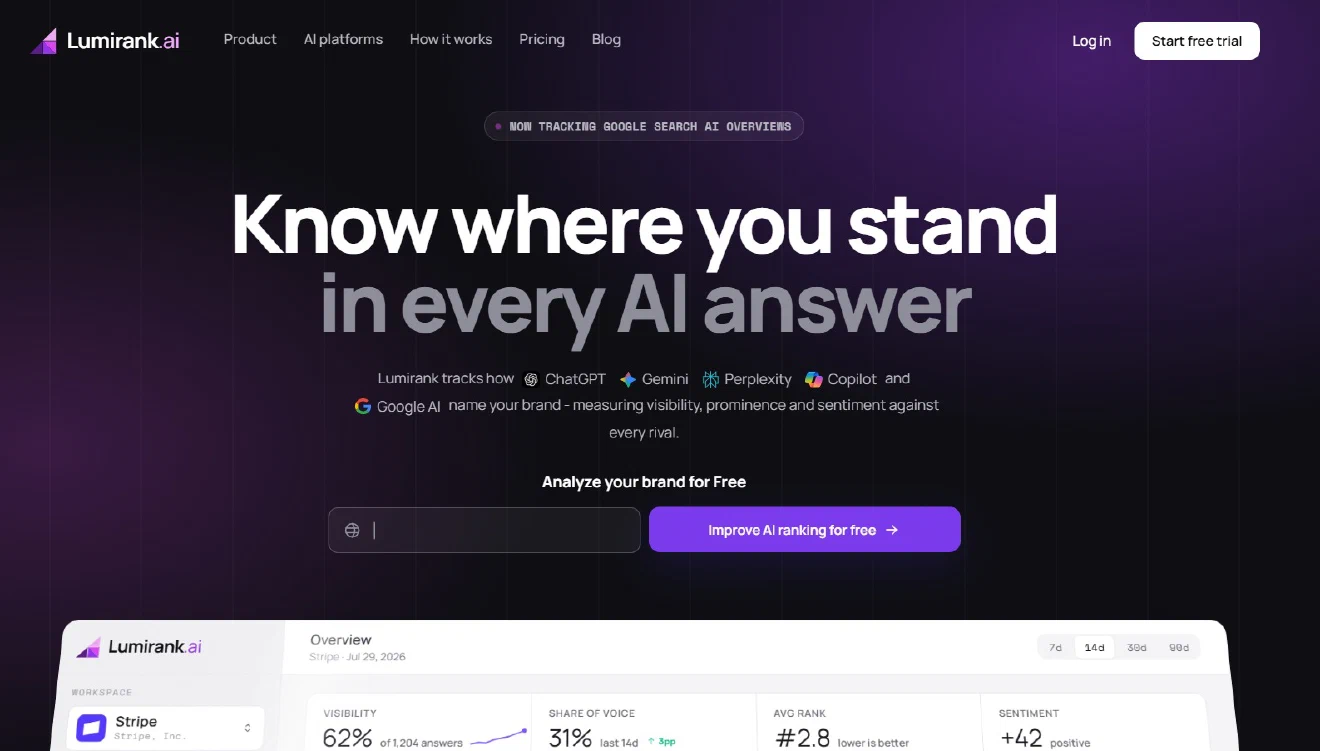
Lumirank tracks brand visibility across ChatGPT, Gemini, Perplexity, Copilot, Google AI Mode and Google AI Overviews, and scores you and every competitor you add on the same six numbers: visibility, prominence, sentiment, citations, competitor share and movement alerts.
The distinction that matters most in practice is the one between visibility and prominence. A brand named once in six can look fine on a raw mention count and still read as a hedge, not a recommendation. Prominence weights where in the answer a brand appears, not just whether it appears, scored on the same 0 to 100 index for every brand in the table, so a rival being named first is visible immediately rather than buried in a mention percentage.
2. Peec AI #
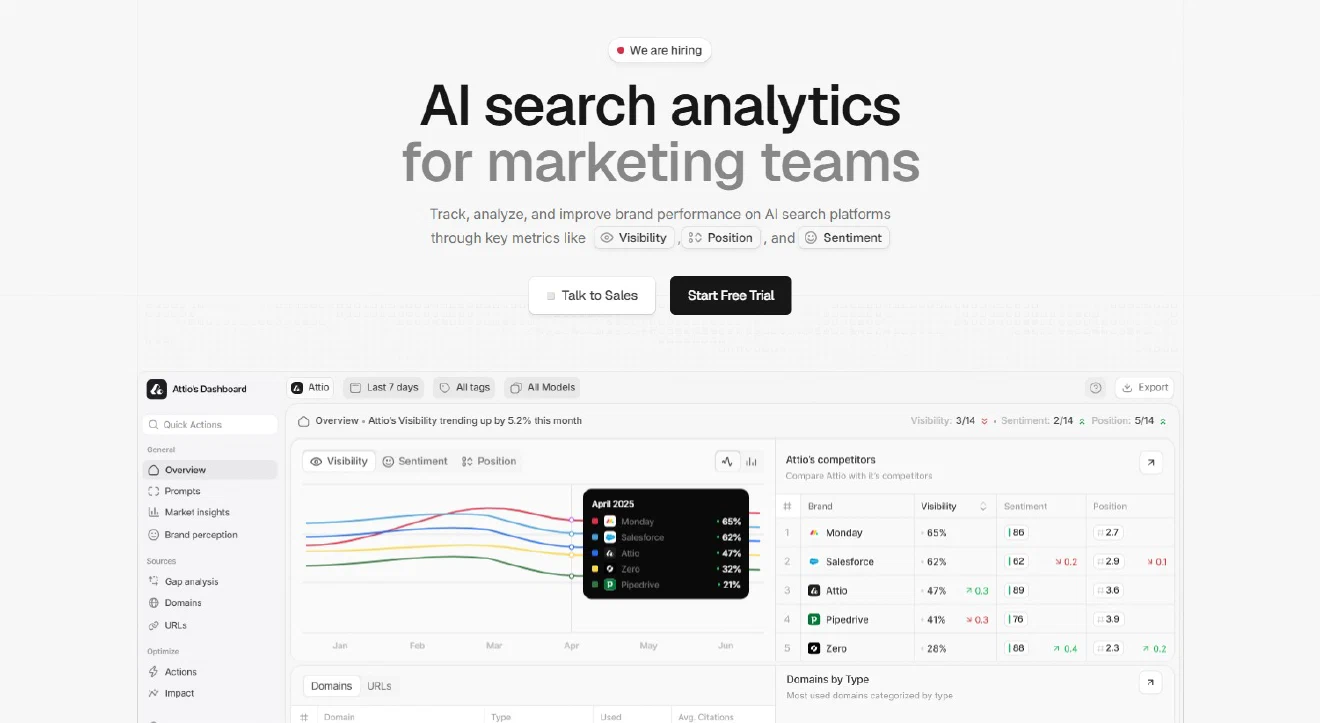
Peec AI does three things and doesn’t try to stretch past them: score visibility, track position, and read sentiment, all tied back to the actual source a model cited. That last part matters more than it sounds. A brand can be cited as a source on a page and never get named directly, or get named without ever being cited, and a plain mention count won’t tell you which one happened. Peec reports the two separately.
Before committing, check how finely the data can be sliced. Splitting results by funnel stage, product line or region is what turns a weekly export into something a team actually acts on, rather than a chart everyone glances at and closes.
3. Otterly.AI #
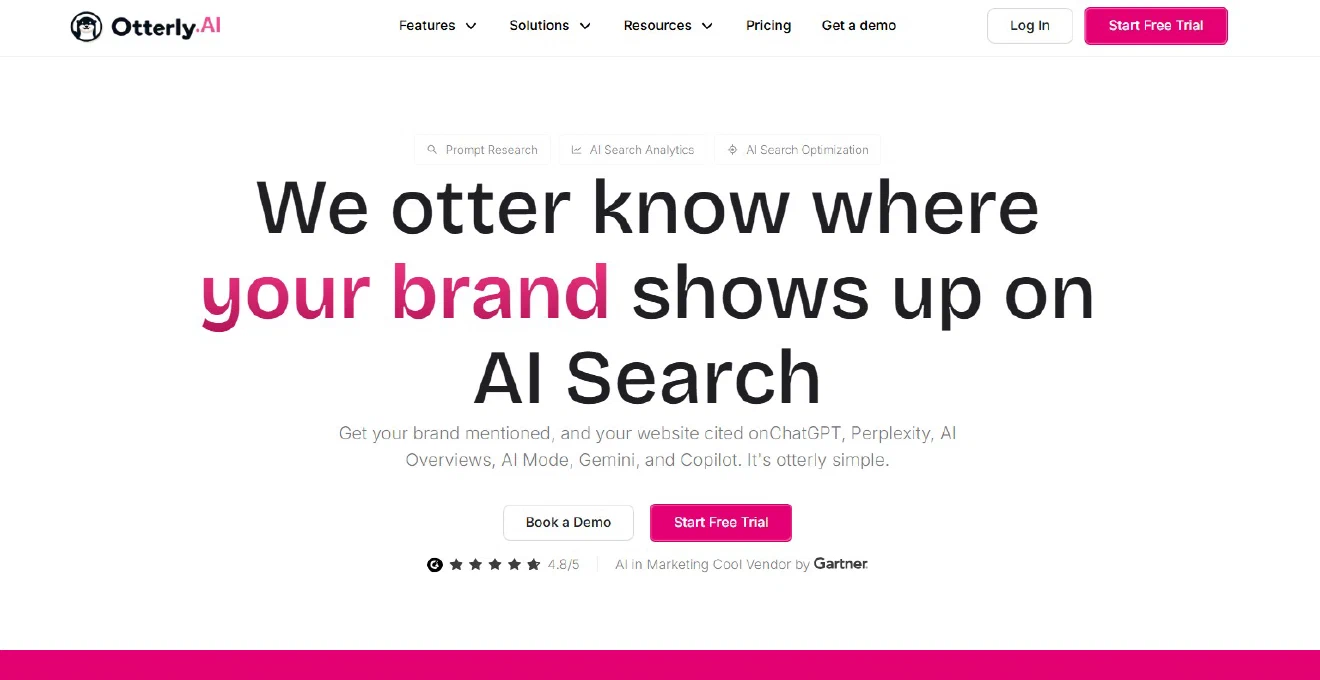
Otterly.AI doesn’t stop at handing back a number. It runs prompt research first, feeds that into AI search monitoring, and then adds a content audit and crawlability checks on the pages that came up short, so the finding and the fix live in one place instead of two tools.
It also keeps a running history of citations and domains over time, alongside sentiment and a visibility index across ChatGPT, Gemini, Perplexity, Copilot, AI Overviews and AI Mode. Worth pressure-testing in a trial: does a visibility drop actually resolve into something concrete, a page to refresh, a crawl error to fix, or does it just sit there as a lower number on a dashboard?
4. Profound #
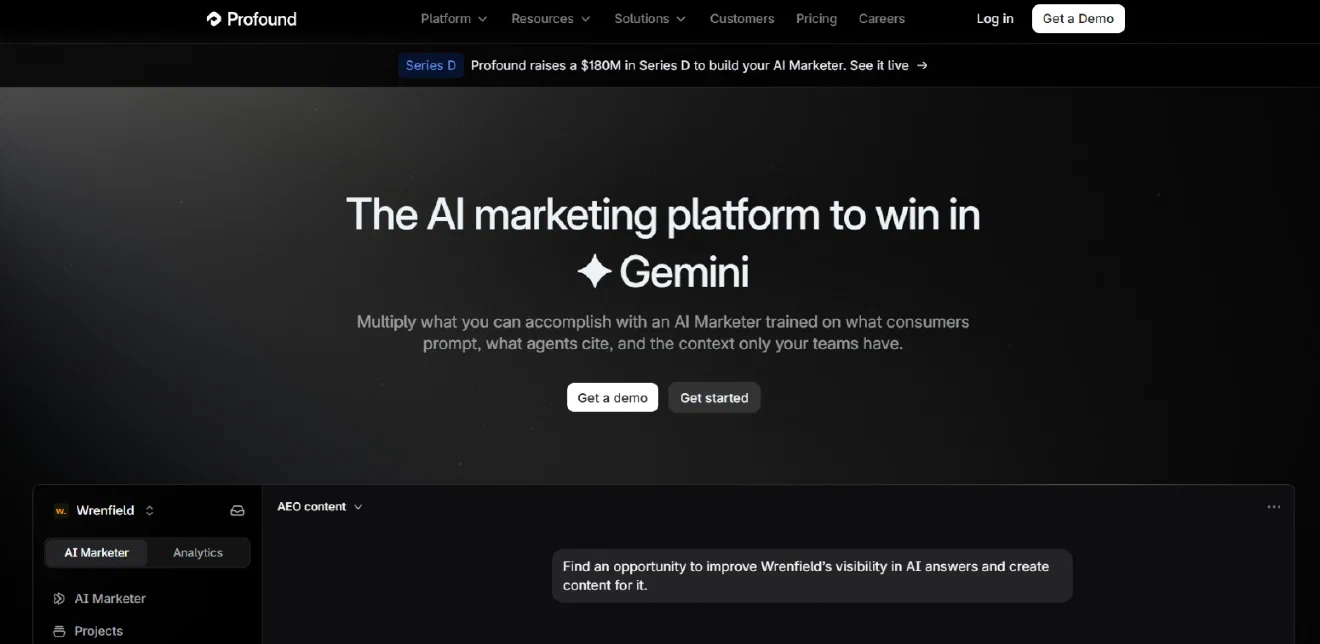
Profound is organized around three pillars, Answer Engine Insights, Prompt Volumes and Agent Analytics, and then layers autonomous agents on top that can act on content and marketing tasks directly. That shape suits organizations where SEO, content and brand already sit as separate functions with their own owners.
What sets it apart from a pure monitoring tool is the attention paid to the technical side: not just whether a brand shows up, but why a crawler read the page the way it did. It earns its price once a team already has a weekly rhythm for turning a finding into a shipped change; without that rhythm, the extra layers mostly go unused.
5. HubSpot AEO #
HubSpot AEO’s real asset isn’t the models it watches, ChatGPT, Perplexity and Gemini, it’s where its prompts come from: your own CRM data, shaped into the ideal customer profiles and buyer stages you already track in HubSpot. Sentiment scoring, competitor benchmarks and citation tracking ride along, plus suggestions on what to fix based on what the data shows.
It runs standalone or as part of Marketing Hub, and the standalone tier caps at 25 prompts a month, so teams tracking more than a handful of queries end up looking at the Hub bundle anyway. For a team already running email, ads and web from HubSpot, folding AI visibility into the same login is the actual reason to pick this over a point tool.
6. Semrush AI Visibility Toolkit #
If your team already lives in Semrush, the AI Visibility Toolkit adds mention tracking, sentiment analysis, prompt discovery, daily monitoring and AI-crawler access checks without opening a second tool. That’s really the whole pitch: one login, one export, one place stakeholders already check.
Before rolling it out past a pilot account, confirm the prompt allowance and add-on costs for your specific plan tier. Semrush varies both by package, and that detail decides whether the toolkit covers a full portfolio or just a sample of it.
7. Scrunch #
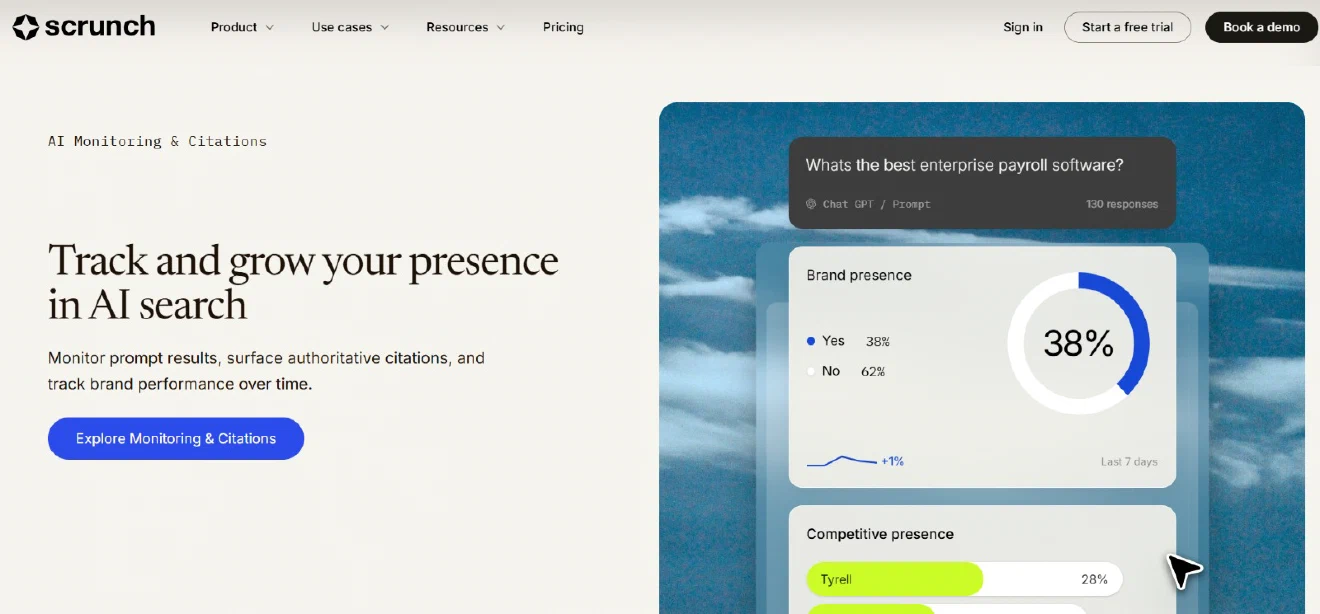
Scrunch frames AI visibility less like an SEO metric and more like a customer-experience one: answer share and citation intelligence, tied to how much actual traffic AI agents are sending a site. Prompt monitoring and citation opportunities feed into the same picture rather than sitting in a separate report.
It fits a team that has already connected AI-origin traffic to pipeline and wants a single scorecard that content, brand and demand can all read the same way, instead of three dashboards telling three different stories.
How to choose #
Pick your stage first, then match the tool to it. Still mapping the category and don’t know who the real players are yet? Weight breadth, how many prompts and rivals a tool can cover in one pass, which is where Ahrefs Brand Radar and Semrush’s toolkit have the edge. Already running a GEO program with a backlog of known gaps? Weight depth instead, how well a tool traces a gap back to a specific source and hands you something to publish or fix, which is closer to what Lumirank, Peec and Otterly are built for.
A tool that shows you where you’re missing is not the same as a plan for closing the gap. Budget for the second part before you buy the first.
Running one platform properly still beats running three half-configured ones. For why a brand’s position in the answer matters more than simply being named, see how generative engines choose which brands to recommend; for what actually earns a citation once you’ve found the gap, see writing pages answer engines can quote.
What to track in the first 90 days #
Settle on a short list of numbers and leave it alone for a full quarter, or every week turns into a debate about methodology instead of progress:
- Mention rate, split by what stage of the funnel the prompt represents.
- Share of citations coming from sources you’d actually trust, versus ones you wouldn’t.
- Where in the answer your brand tends to land when it’s named at all.
- Sentiment, broken out by product line rather than one blended brand score.
- How often a competitor wins your highest-value prompts instead of you.
These map directly to what Lumirank scores by default, but the tool matters less than the discipline: change the prompt set every week and there’s no way to know if a number moved because of your work or because you asked a different question.
How to set up AI search visibility monitoring #
Follow this loop instead of just watching a dashboard.
- Define what you track. List your brand names, product names, and the 2 or 3 rivals you actually compete with in an AI answer. Group prompts by funnel stage so a number ties back to a business outcome.
- Pick one platform, plus a manual check. Run a primary tool daily. Re-run a small prompt set by hand each week to catch model drift or prompt bias a dashboard misses.
- Track 5 metrics every week. Mention rate, citation rate, position in the answer, sentiment, and competitor share of voice, split by model and funnel stage.
- Find the citation gaps. Sort for prompts where a rival’s page is the source and yours isn’t. Prioritize the ones you can fix fastest with stronger evidence or clearer schema.
- Ship one fix a week. Publish or refresh a page, tighten crawlability, or clarify an entity. Compare the next week’s numbers for that prompt cluster before moving to the next gap.
Frequently asked questions #
What is AI search analytics monitoring? #
It is the practice of tracking how often, where and how favorably an AI model such as ChatGPT, Gemini, Perplexity or Google AI Overviews names your brand in its answers, then comparing that against the same numbers for your competitors.
Is this the same as classic SEO rank tracking? #
No. Classic rank tracking measures position on a search results page. AI visibility tracking measures whether and how a brand is named inside a generated answer, which draws on a different, smaller set of sources and rewards different signals.
Is Lumirank free to try? #
Yes. The free plan tracks 10 prompts on one brand across two of the six supported AI models, with daily updates, visibility, citations and sentiment included. The Pro plan adds a 14 day trial with no card required for all six models.
How many AI platforms should I track? #
Cover the platforms your buyers actually use to research a purchase. Most B2B teams start with ChatGPT, Gemini and Google AI Overviews, then add Perplexity and Copilot once a baseline exists.
Conclusion #
AI search visibility isn’t a side experiment anymore, it’s a number someone on the team checks every week, the same way they’d check Search Console. What separates the tools above isn’t how many charts each one produces. It’s whether the output points at something specific: a page to rewrite, a citation to chase, a competitor gaining ground on a prompt that actually matters to the business.
If you haven’t measured this yet, start with a free scan. Ten tracked prompts and two AI models are enough to find out whether your brand shows up in an AI answer at all, before deciding how far to take it.