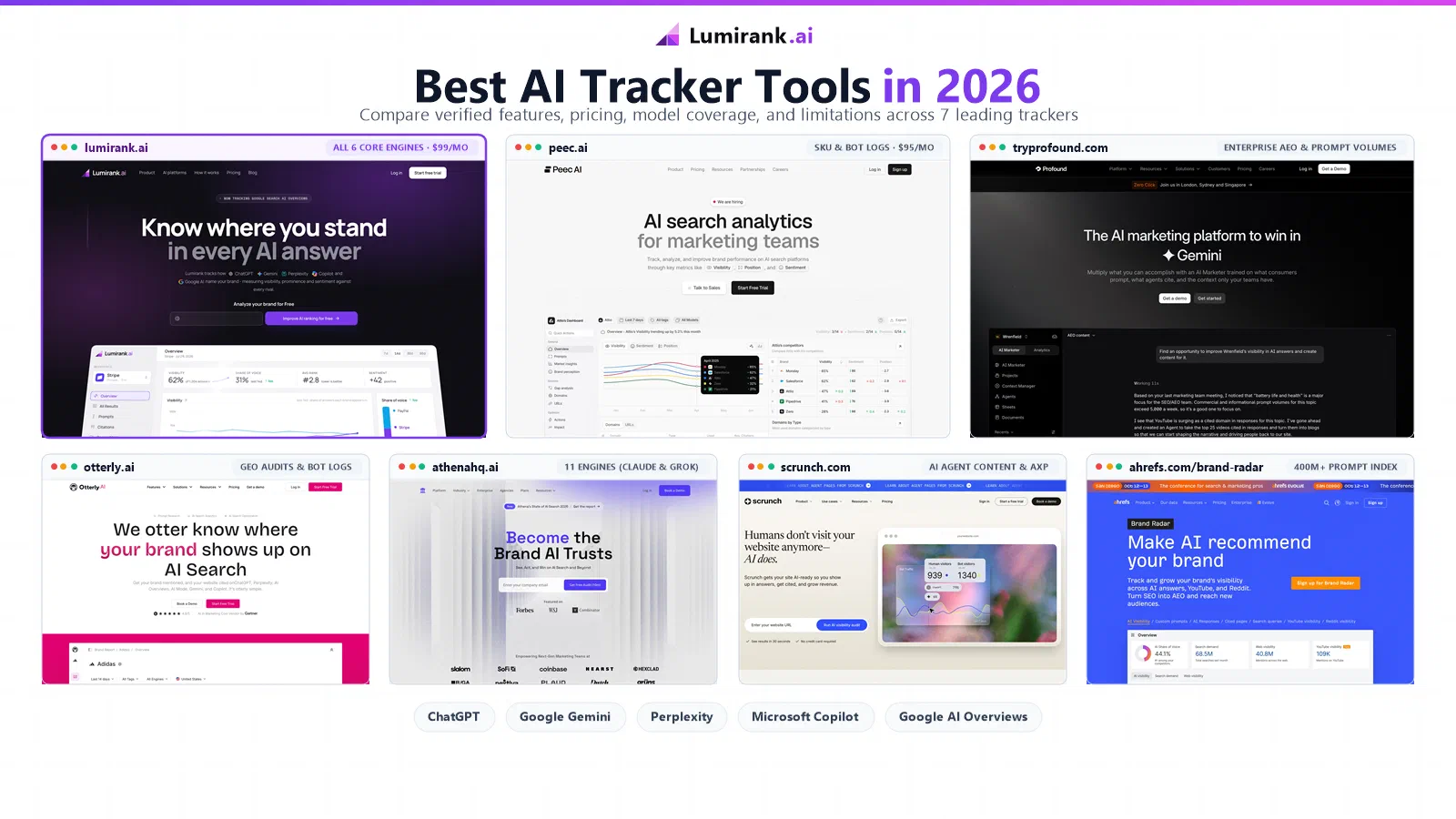
Buyers now ask ChatGPT, Google Gemini, Perplexity, Microsoft Copilot, and Google AI Overviews for product recommendations instead of browsing ten blue links. A company can hold top organic positions on Google search and still remain completely absent from an AI answer. Dedicated AI search visibility tracking tools query generative engines at scale to measure brand mentions, ranking positions, citations, and sentiment.
This guide reviews seven active AI search tracking tools in 2026 across identical criteria: core platform coverage, tracking capabilities, best use case, verified pricing, and documented limitations. We cover six dedicated daily trackers and select Ahrefs Brand Radar as the seventh tool to compare index-based prompt discovery against daily custom-prompt trackers.
In short
- AI search engines evaluate sources differently than traditional web search. Holding the top rank on Google search does not guarantee that ChatGPT, Gemini, or Perplexity will mention your product.
- Trackers meter usage through prompts, credits, or checks. Knowing whether a vendor charges per seat, per model, or per prompt run determines the true monthly cost of your setup.
- Core consumer engines generate the highest commercial volume. ChatGPT, Google Gemini, Perplexity, Copilot, and Google AI Overviews shape the majority of purchasing research.
- Choose between daily custom tracking and broad prompt discovery. Platforms like Lumirank and Peec AI track core prompts daily, while indexes like Ahrefs scan hundreds of millions of pre-computed queries.
Compact comparison table #
This table compares verified monthly starting prices, engine coverage, refresh schedules, seat rules, and core capabilities across all seven tools.
| Tool | Starting Price | Models Included | Refresh | Seats | Standout Capability |
|---|---|---|---|---|---|
| Lumirank | Free, then $29 / mo | All 6 on Pro ($99 / mo) | Daily | Unlimited | All 6 core engines at $99 / mo with no seat caps |
| Peec AI | $95 / mo | 3 models | Daily | Unlimited | SKU shopping tracking and 40+ crawler bot logs |
| Profound | Enterprise | Up to 9 models | Daily | Custom | Consumer prompt volume data and agent workflows |
| Otterly.AI | $29 / mo | 4 models (add-ons extra) | Daily | Unlimited | Technical GEO URL audits and server bot logs |
| AthenaHQ | Free, then $295 / mo | 11 models | Credit-based | Unlimited | Broad coverage including Claude, Grok, and DeepSeek |
| Scrunch AI | $250 / mo | 4 models (no Gemini) | Every 72h | 5 on Core | Agent Experience Platform (AXP) for AI crawler delivery |
| Ahrefs Brand Radar | $129 / mo | 6 models | Monthly index | Plan-based | Prompt discovery across 400M+ real search queries |
The 7 best AI tracker tools in 2026 #
Here are the 7 best AI search visibility tracking tools in 2026, reviewed in order with verified features, platform coverage, pricing, and limitations.
1. Lumirank #
Lumirank tracks daily brand visibility across ChatGPT, Google Gemini, Perplexity, Microsoft Copilot, Google AI Overviews, and Google AI Mode. Users track brand mentions, visibility rates, prominence (a 0 to 100 position index that weights where in the response a brand appears), sentiment from -100 to +100, competitor share of voice, and citations categorized into owned, earned, and competitor pages. All plans include unlimited team seats.
- Best use case: Marketing teams and agencies needing daily tracking across all six core consumer AI engines with unlimited seats and no engine add-on fees.
- Verified pricing: Free plan covers 10 prompts across 2 models at $0 forever. Starter is $29 a month for 25 prompts. Pro is $99 a month for 100 prompts across all 6 models with a 14-day cardless trial. Scale is $399 for 450 prompts.
- Limitation: Lumirank does not track Claude, Grok, or DeepSeek, and currently lacks server crawler log tracking.
2. Peec AI #
Peec AI tracks how AI answers cite brands across ChatGPT, Perplexity, Gemini, Google AI Overviews, AI Mode, and Copilot. Users track brand mentions, ranking positions, sentiment, citations, e-commerce SKU visibility in shopping answers, and crawler bot visits from over 40 AI bots.
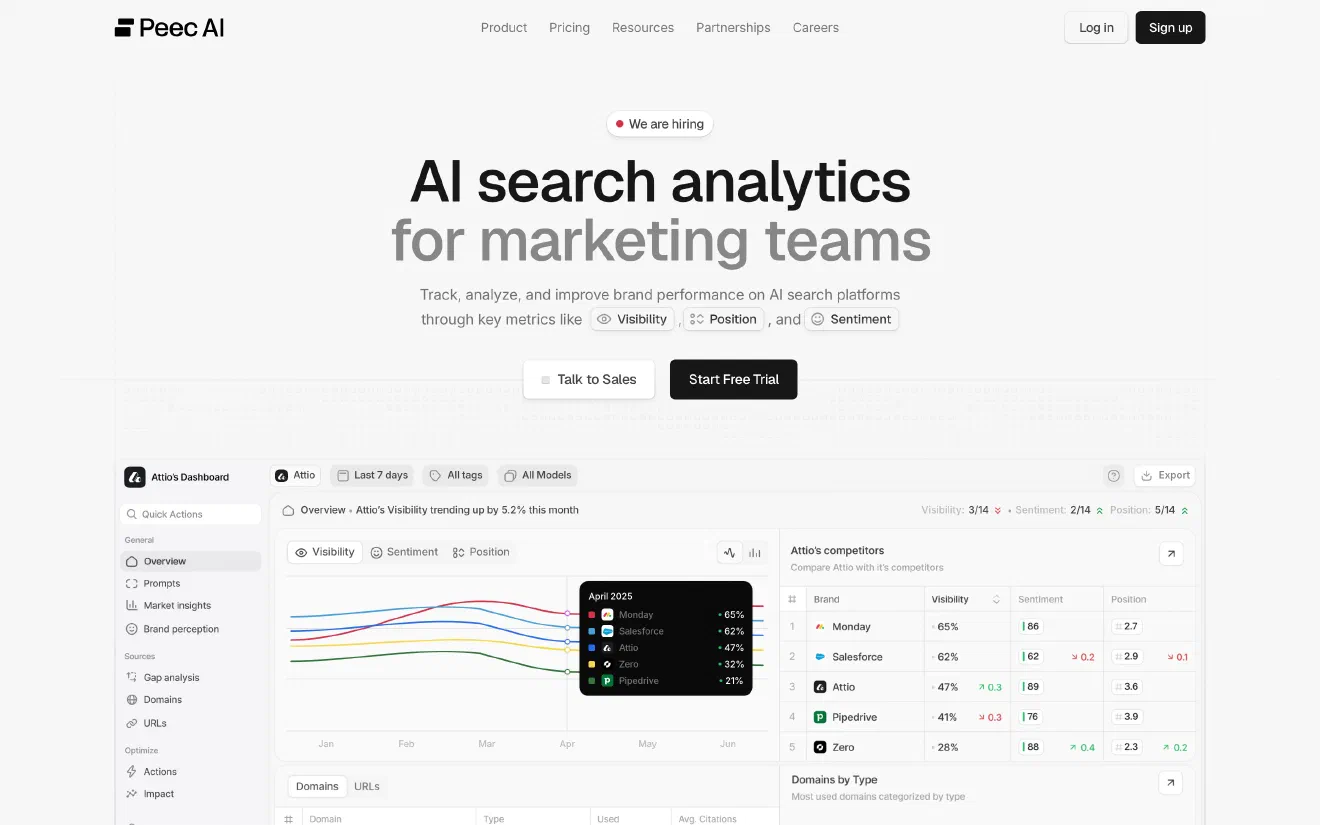
- Best use case: E-commerce brands needing product SKU tracking and crawler logs alongside standard GEO metrics.
- Verified pricing: Starter is $95 a month for 50 prompts across 3 models. Pro is $245 for 150 prompts. Adding a 4th model on Pro costs $85 a month. Enterprise begins at $495 a month.
- Limitation: Standard plans limit coverage to 3 models, a 4th model costs $85 a month, Claude requires an Enterprise contract, and there is no free tier.
3. Profound #
Profound captures answers across up to nine engines, including ChatGPT, Gemini, Perplexity, Claude, DeepSeek, and Copilot, using browser sessions. Users track brand mentions, answer rankings, sentiment, citations, competitor share of voice, and Prompt Volumes, which estimates real search query demand using consumer panels in ten countries.
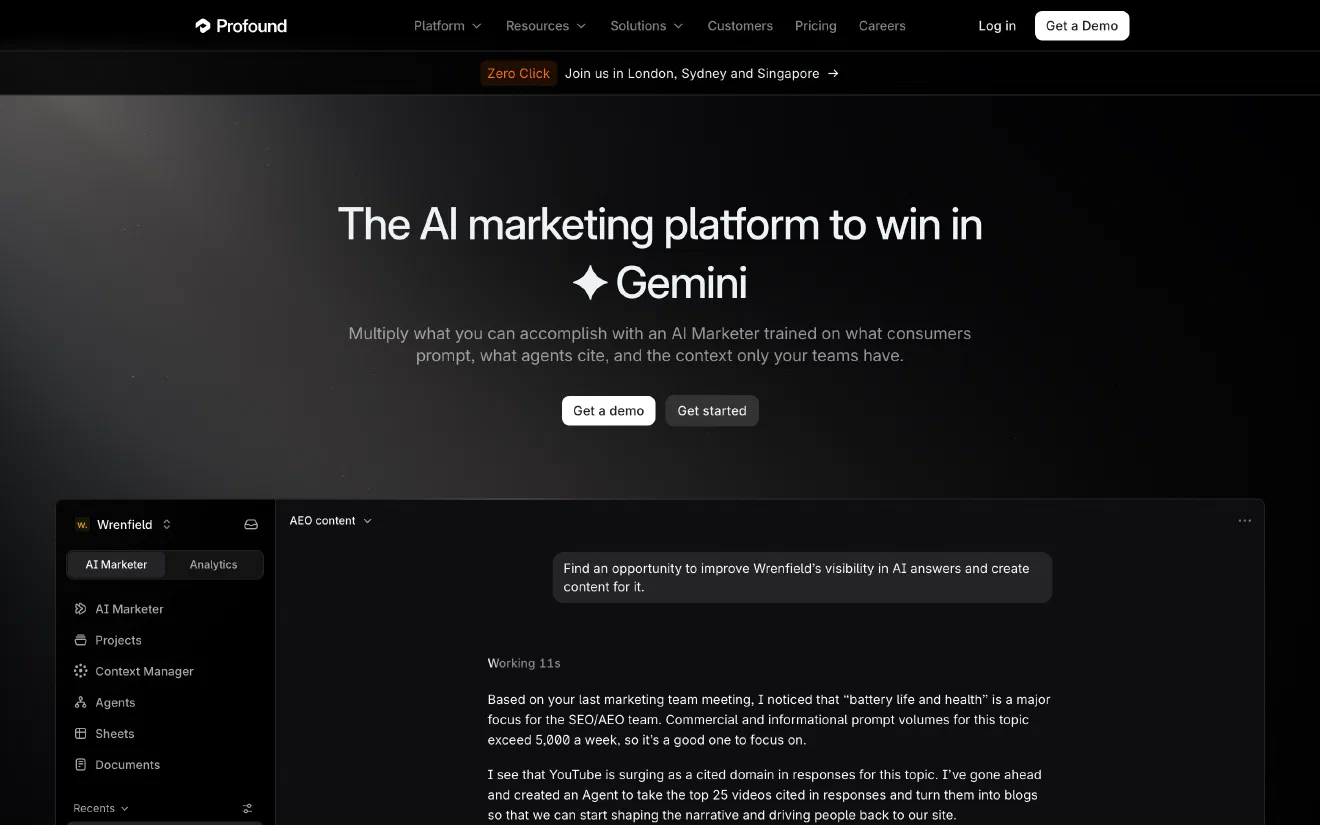
- Best use case: Enterprise brands needing consumer search volume data, crawler log validation, and agent workflows.
- Verified pricing: A 7-day trial includes 50 fixed prompts. Paid access requires custom Enterprise contracts ($2,000 to $5,000+ monthly). Self-serve plans were retired in September 2026.
- Limitation: There are no self-serve monthly plans, and trial prompts cannot be customized, wich prevents smaller teams from adopting it.
4. Otterly.AI #
Otterly.AI simulates neutral user searches across 65+ countries on ChatGPT, Google AI Overviews, Perplexity, and Copilot. Users track brand mentions, ranking positions, sentiment, citation domains over time, competitor visibility, and server bot visits. It also provides an AI Prompt Research tool and technical GEO URL audits.
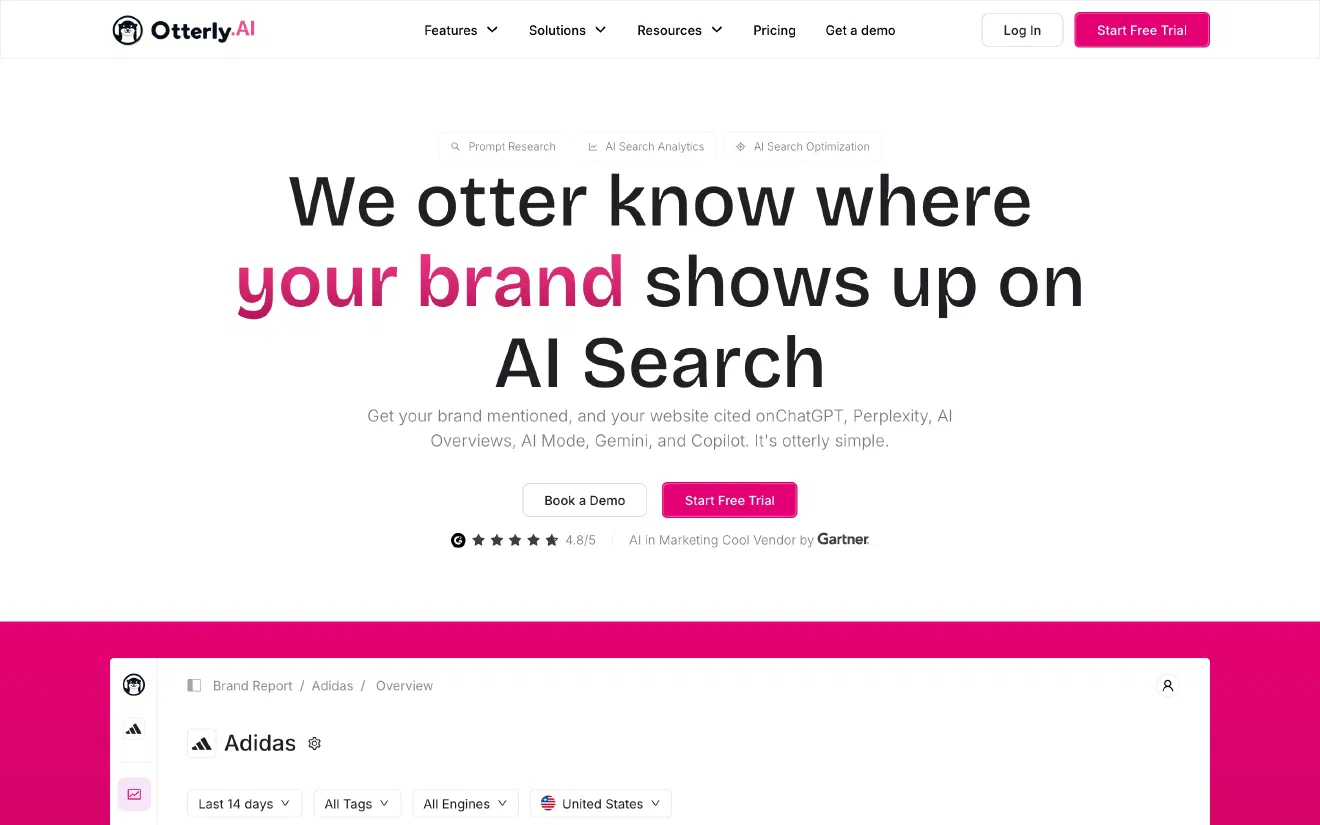
- Best use case: Mid-sized teams wanting daily tracking paired with technical page audits and international prompt checks.
- Verified pricing: Lite is $29 a month for 15 prompts. Standard is $189 a month for 100 prompts across 4 engines. Premium is $489 a month for 400 prompts.
- Limitation: Standard plans exclude Gemini and AI Mode, requiring $59 monthly add-ons each, while Claude costs $109 extra, substantially increasing total costs.
5. AthenaHQ #
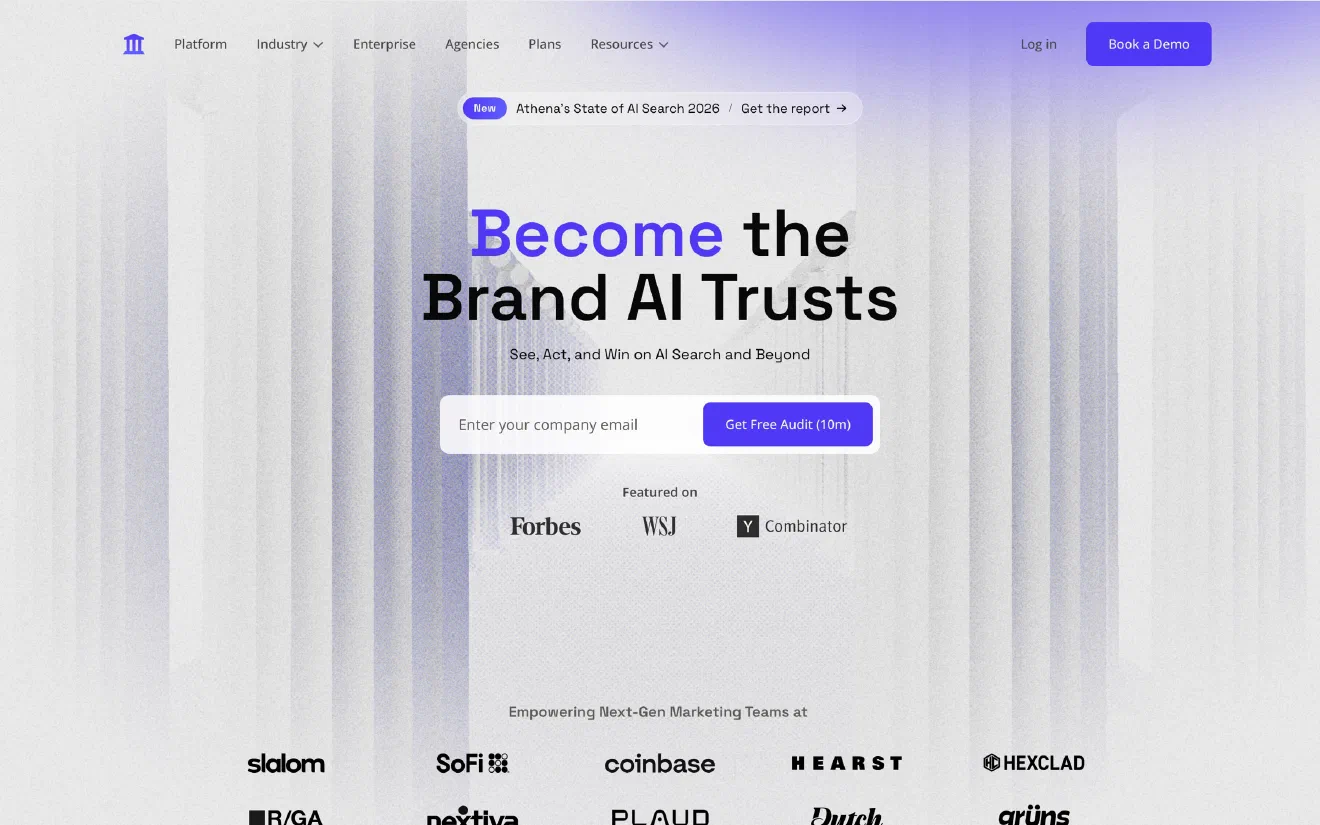
AthenaHQ monitors brand mentions and citations across 11 generative engines: ChatGPT, Perplexity, Gemini, Claude, Grok, DeepSeek, Copilot, Meta AI, Mistral, AI Overviews, and AI Mode. Users track brand citations, unified GEO scores, sentiment ratings, competitor answer share, and referral traffic via direct Google Analytics 4, Shopify, and Webflow connectors.
- Best use case: Brands prioritizing frontier models like Claude and Grok with direct CMS and analytics integrations.
- Verified pricing: Essential is free with 300 monthly credits. Starter is $295 a month ($270 billed annually) for 3,600 credits across 11 models with unlimited seats. Enterprise provides custom credit tiers.
- Limitation: The credit meter empties quickly on daily tracking. Running 30 prompts across 4 models daily consumes 3,600 credits a month, exhausting the Starter tier.
6. Scrunch AI #
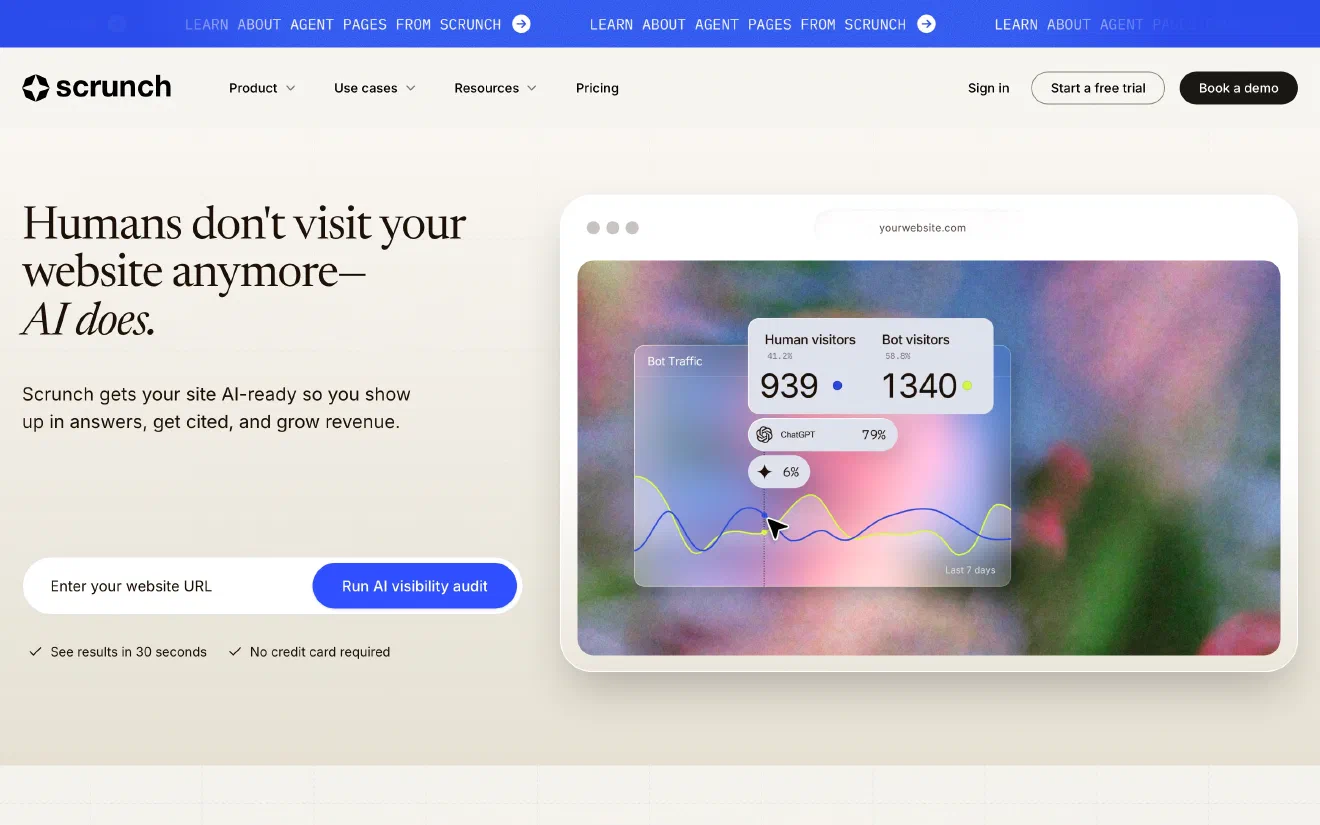
Scrunch AI, acquired by Sitecore in 2026, pairs visibility tracking with content delivery for AI web crawlers. The Core plan monitors ChatGPT, Perplexity, Google AI Overviews, and Copilot for 125 prompts. Users track answer share, brand mentions, cited domains, crawler visits, and crawlability health, with an Agent Experience Platform (AXP) on Enterprise to serve structured pages to AI crawlers.
- Best use case: Enterprise organizations in the Sitecore ecosystem combining brand tracking with structured content delivery for AI crawlers.
- Verified pricing: Core is $250 a month on annual billing (roughly $300 monthly) for 125 prompts and 5 user seats. Enterprise requires custom pricing.
- Limitation: Prompts refresh only every 72 hours after day 14 on Core, Google Gemini is excluded, and user logins are capped at 5.
7. Ahrefs Brand Radar #
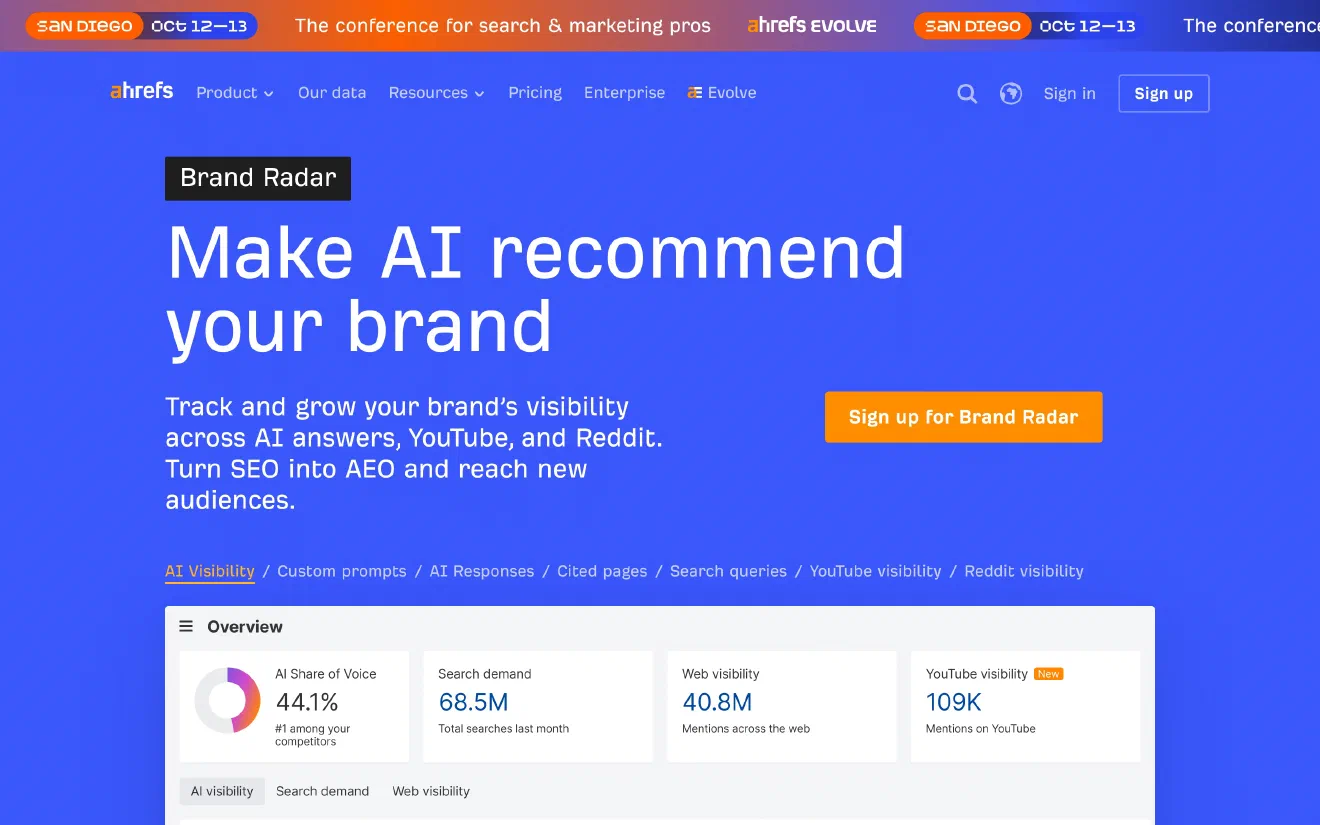
Ahrefs Brand Radar checks brand presence across an index of more than 400 million prompts built from search queries and People Also Ask questions. Users track brand mentions, share of voice, sentiment, and cited sources across ChatGPT, Gemini, Perplexity, Copilot, AI Overviews, and AI Mode. We selected Ahrefs as the seventh tool because it solves prompt discovery at scale, uncovering queries where your brand or rivals appear without requiring manual prompt setup.
- Best use case: SEO and brand teams already on Ahrefs wanting broad prompt discovery across hundreds of millions of consumer queries.
- Verified pricing: Requires an Ahrefs plan starting at $129 a month (Lite, with 150 prompt checks). Extra check packs cost $50 for 2,500 checks. AI prompt index access is an add-on from $199 to $699 a month.
- Limitation: The 400M+ prompt index refreshes monthly rather than daily, daily tracking of custom prompts requires metered check purchases, and raw reports do not filter out hallucinated citation URLs.
How to choose the right AI tracker #
Match the tool to your primary operational priority:
- For daily tracking across core engines: Lumirank tracks all six major consumer AI engines from $99 a month with unlimited seats.
- For e-commerce SKU tracking: Peec AI monitors brand mentions and SKU placements in shopping answers.
- For consumer query search volume: Profound estimates prompt demand using consumer panel data.
- For technical GEO page audits: Otterly.AI audits whether page structures support AI citations.
- For frontier model coverage: AthenaHQ tracks 11 models with native CMS connectors.
- For serving content to bots: Scrunch AI pairs tracking with structured page delivery.
- For large-scale prompt discovery: Ahrefs Brand Radar queries 400M+ pre-indexed prompts.
For why visibility shifts quickly, read how generative engines choose which brands to recommend. For foundational ranking principles, see traditional SEO versus GEO.
Conclusion #
AI search engines have altered how buyers evaluate products. Tracking brand mentions and citations across ChatGPT, Google Gemini, Perplexity, and Copilot provides the empirical data required to protect brand reputation and capture generative search demand.
Review your target audience, identify your core prompts, and test candidates on your highest-value queries for two weeks to determine which tracker matches your workflow.