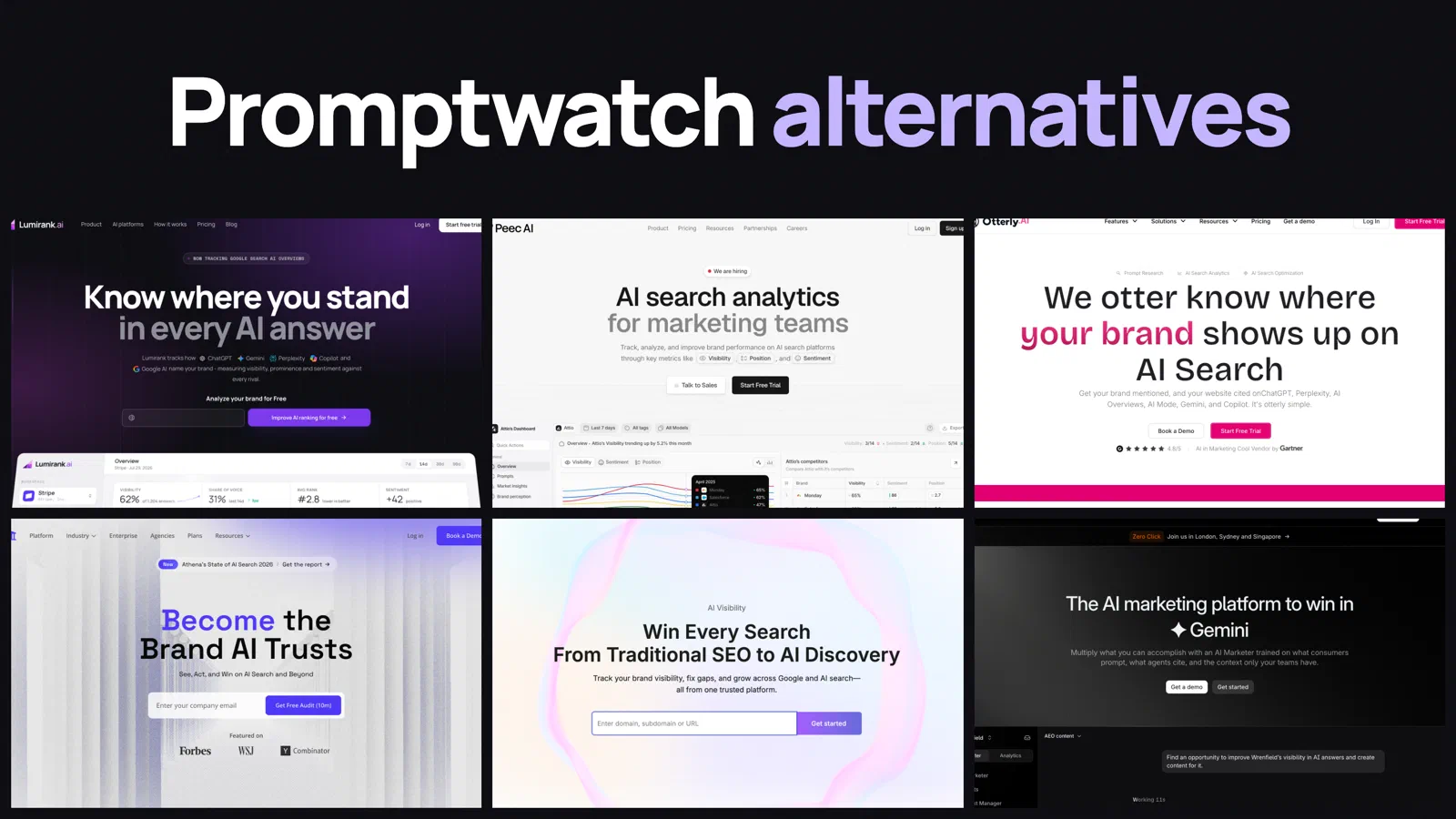
Say you run marketing at a UK payment gateway. There are 3 of you, and you want to know whether ChatGPT, Perplexity, Gemini and Google’s AI Overviews name your company when a founder asks for the best payment gateway for a UK SaaS business. Promptwatch is a common place to start, and it is a good tool. Lining it up against the alternatives is harder than it looks, though, because every vendor lists the same features. What actually separates them is what one concrete job costs and how often each tool runs it. So this post prices one common setup on every tool: 100 prompts on 4 AI apps, run every day. On Promptwatch that costs $245 a month, or $579 once a third person on your team needs a login.
In short
- Compare tools on one setup. 100 prompts on 4 AI apps every day is 12,000 answers a month. Promptwatch charges $245 for that with 2 seats, and $579 on the plan with 5.
- Lumirank runs that setup for $99 a month, on all 6 of its AI apps, with unlimited team members.
- Peec AI and Otterly.AI are the closest like-for-like swaps, with unlimited seats, at $330 and $248 a month for the same setup.
- Credit-based and weekly tools cost less if you can live with fewer runs: AthenaHQ, Rankscale and LLMrefs.
- The top end moved up. Profound dropped its public self-serve plans in September 2026.
The 10 alternatives at a glance #
Prices come from each vendor’s pricing page on 24 September 2026, on monthly billing. The third column prices one common setup on each tool: 100 prompts on ChatGPT, Perplexity, Google AI Overviews and Gemini, run daily.
| Tool | Starts at | 100 prompts, 4 AI apps, daily | Refresh | Seats |
|---|---|---|---|---|
| Lumirank | Free, then $29 | $99 | Daily | Unlimited |
| Promptwatch (for reference) | $95 | $245 | Daily | 1, 2 or 5 |
| Peec AI | $95 | $330 | Daily | Unlimited |
| Otterly.AI | $29 | $248 | Daily | Unlimited |
| AthenaHQ | Free credit, then $295 | $295, run weekly | You set it | Not stated |
| Rankscale | $20 | $385 daily, $99 weekly | Hourly to monthly | Unlimited |
| LLMrefs | $79 | $79, run weekly | Weekly | Unlimited |
| Semrush AI Visibility Toolkit | $99 | $219, Perplexity weekly only | Daily | Extra users cost extra |
| Ahrefs Brand Radar | $129 plan | About $330 in checks | Monthly index, custom prompts daily | Per Ahrefs plan |
| Scrunch | $250 | $250, no Gemini | Every 72 hours after day 14 | 5 |
| Profound | Free trial | Contact sales | Daily | Custom |
What Promptwatch sells #
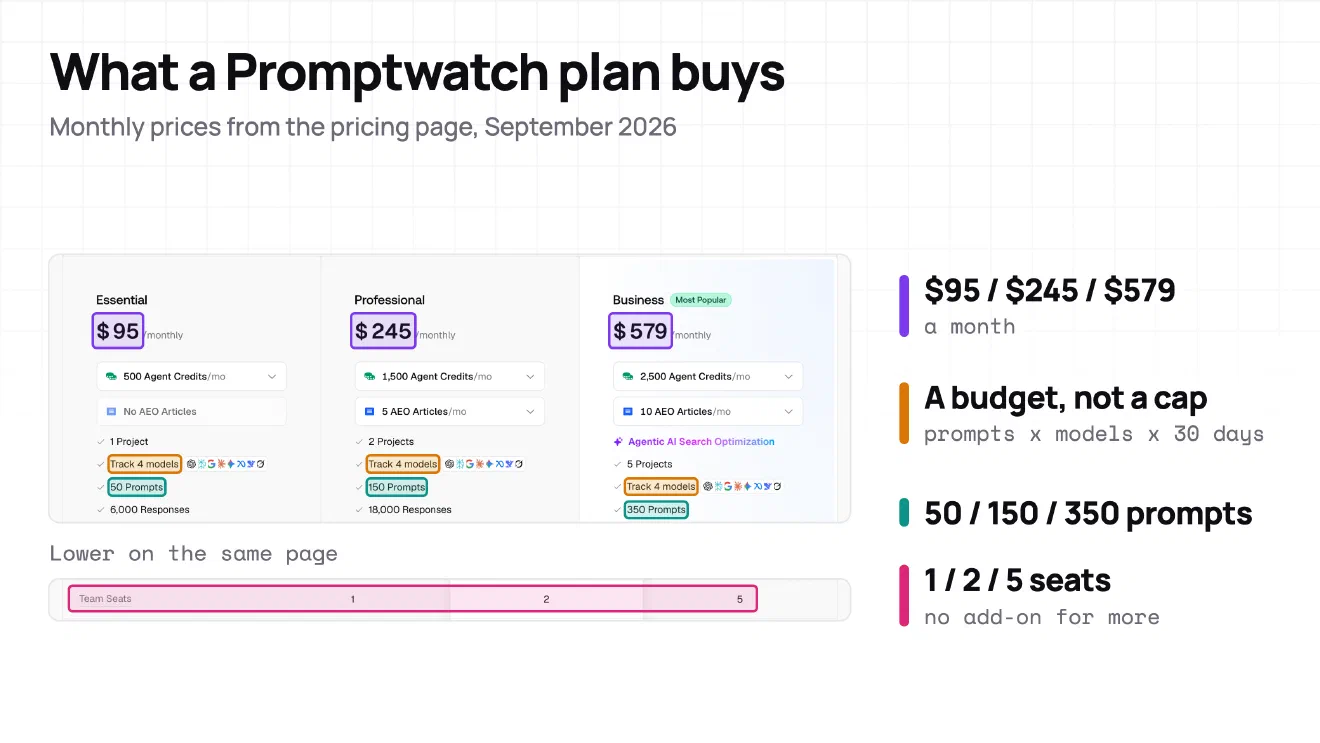
Promptwatch is an Amsterdam company that launched in April 2025, raised a €6M seed round in July 2026, and reported €2M in annual recurring revenue by May (Sifted). Its pricing page has 3 plans. Essential is $95 a month for 50 prompts, Professional $245 for 150, and Business $579 for 350.
Every plan card says “Track 4 models”, which sounds like a cap on AI models. Promptwatch’s own docs describe it as a response budget instead: prompts x models x 30 days (response limits). Essential buys 50 x 4 x 30 = 6,000 answers a month, and you can spend them across any of the 11 models in the pricing grid. For ChatGPT, Gemini, Perplexity, Copilot, AI Overviews and AI Mode, it drives the real apps rather than calling an API, so it records the answer a buyer would see (how Promptwatch collects data).
100 prompts on 4 AI apps, daily, is 100 x 4 x 30 = 12,000 answers. Professional covers that with room to spare, at 18,000. The catch is seats. Essential has 1, Professional 2 and Business 5, and the pricing page lists no way to add one. A team of 3 on 100 prompts pays $579 for Business, not $245.
It does more than track, which is why people pick it. Professional and Business include crawler log allowances of 25M and 100M. Content Gap Analysis maps your pages against the answers you are missing from. A Content Agent writes “AEO articles”, 5 a month on Professional and 10 on Business, and can publish them to Webflow, Framer or WordPress. API and MCP access come with every plan.
The complaints are few, and most are about fit rather than quality. Price per prompt barely moves as you go up: $1.90 on Essential, $1.63 on Professional, $1.65 on Business. One agency user who ran it for 60 days reported “more UX errors and bugs than other solutions” and no way to escalate (Generate More). G2 reviewers, as quoted by competitors, mention a steep learning curve. That is thin evidence either way, so weigh it lightly.
- Pros: 11 AI models to pick from, collection from the real AI apps, crawler logs, an article writer.
- Cons: 1, 2 or 5 seats with no add-on, and price per prompt barely drops as you scale.
- Pricing: $95 / $245 / $579 a month for 50 / 150 / 350 prompts.
The 10 alternatives #
1. Lumirank #
Lumirank, the tool behind this blog, covers the monitoring half of the job. It runs your prompts daily on ChatGPT, Gemini, Perplexity, Copilot, Google AI Mode and Google AI Overviews, in the countries you pick, and tracks visibility, citations and how you rank against the competitors you add. The Pro plan covers 100 prompts on all 6 AI apps, daily, with unlimited team members, for $99 a month. That is the lowest price on this list for 100 daily prompts on 4 or more AI apps, and Pro comes with a 14-day trial and no card.
The trade is scope. Lumirank does not write articles, read your server logs, or track Claude and Grok, and its pricing page lists the API, MCP server and exports as coming soon. If Promptwatch’s content side is what you use most, it will not replace that. If what you need is a clean daily read on 6 AI apps for a whole team, it is the cheapest way to get it here.
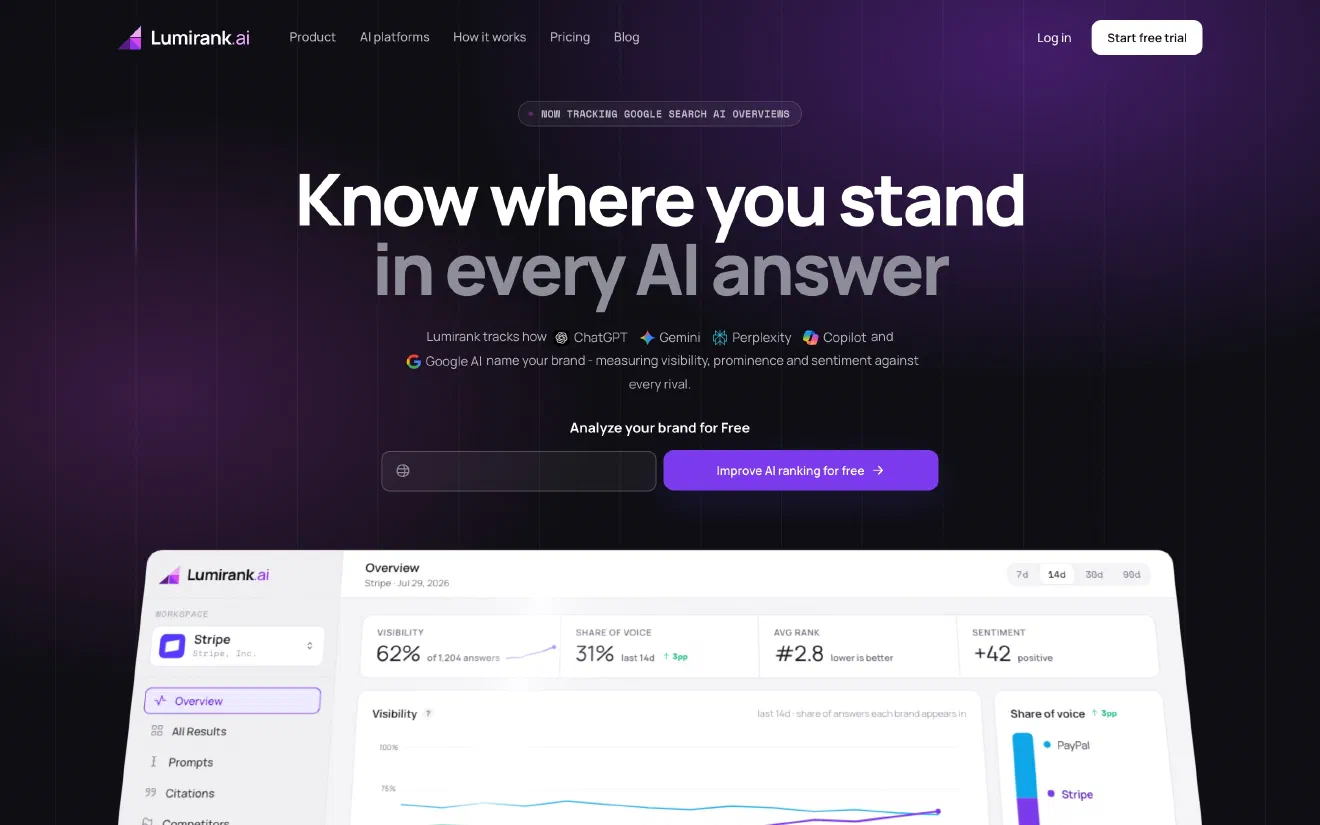
- Pros: all 6 AI apps on Pro, unlimited team members, daily runs, a free plan with no card.
- Cons: no Claude, Grok or DeepSeek, no crawler logs or article writer, API and exports still “coming soon”.
- Pricing: free for 10 prompts, then $29 / $99 / $399 a month for 25 / 100 / 450 prompts.
2. Peec AI #
Peec AI is the closest thing to a like-for-like swap. The price ladder is almost the same as Promptwatch’s. The difference that matters for most teams is seats: every Peec plan has unlimited users.
The other difference is which AIs you get. Each plan includes 3 models, picked from ChatGPT, Perplexity, AI Overviews, AI Mode, Gemini and Copilot (Peec’s model list), and a 4th costs $85 a month on Pro. So 100 daily prompts on 4 AI apps comes to $245 + $85 = $330. Claude, Grok, DeepSeek and the rest are Enterprise only, through APIs. One oddity to check during the trial: the pricing table and the model list disagree on whether Perplexity is available below Enterprise.
Peec is a Berlin company that raised a $21M Series A in November 2025 and, according to TechCrunch’s sources, passed $10M in annualised revenue by May 2026. This year it added crawl insights for 40+ AI bots, SKU-level AI Shopping tracking in June, and brand fact-checking in August. Pick it if seats are why you are leaving Promptwatch and you don’t need the article writer.
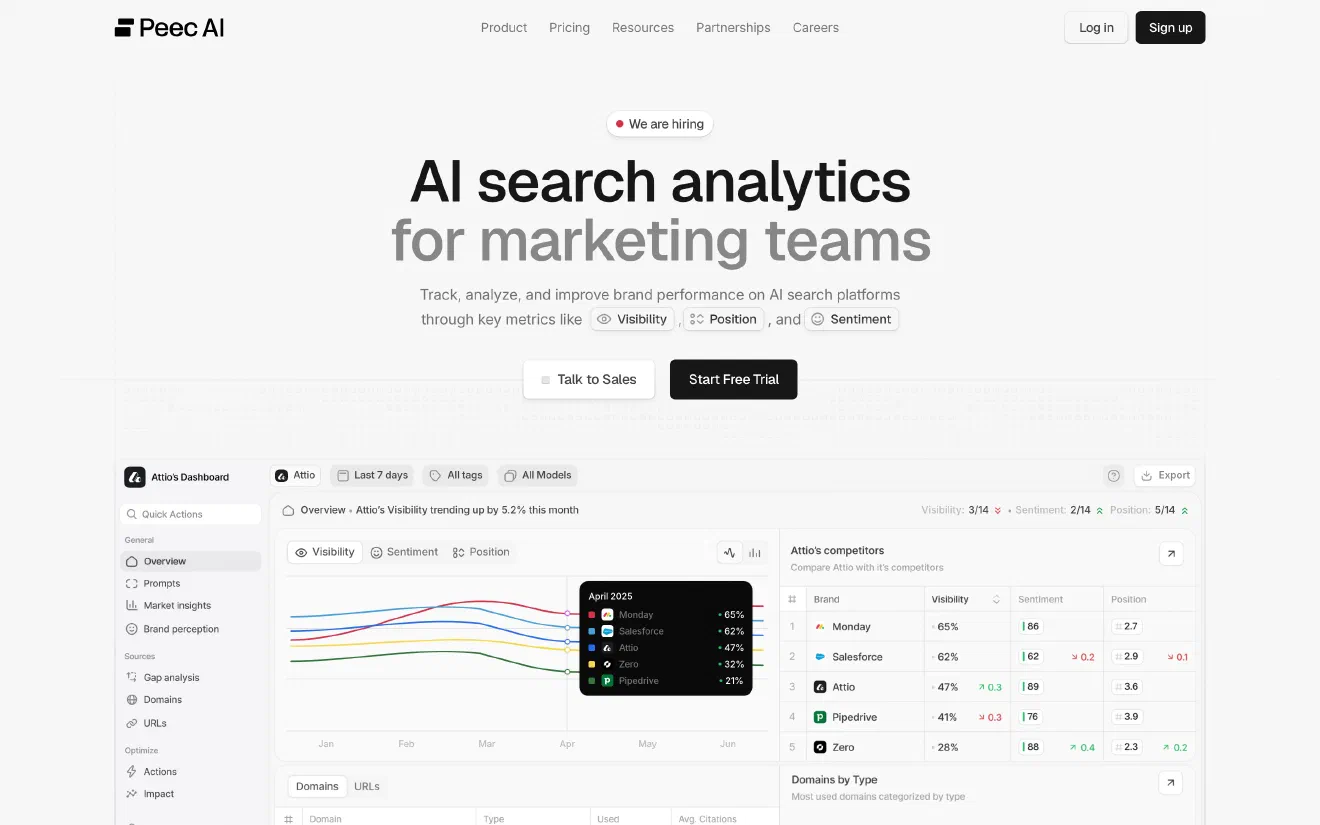
- Pros: unlimited users on every plan, daily runs, crawl insights and AI Shopping tracking.
- Cons: 3 models per plan, a 4th costs $85 a month on Pro, no article writer.
- Pricing: $95 / $245 / $495 a month for 50 / 150 / 350 prompts.
3. Otterly.AI #
Otterly.AI is the cheapest serious entry point, and every plan has unlimited seats. ChatGPT, AI Overviews, Perplexity and Copilot are included. AI Mode and Gemini are add-ons at $59 each on Standard, and Claude is $109. 100 prompts on ChatGPT, Perplexity, AI Overviews and Gemini means Standard plus Gemini: $248 a month.
It has grown well past a basic tracker this year. A public API shipped in June, Claude tracking later that month, and Agent Analytics (server-log tracking of AI bots, 200K events a month on Standard) in August. Standard and Premium also include MCP access. The GEO Audit checks single URLs for on-page issues. Otterly queries each AI app “as a neutral, non-personalized user”, daily, per country (help centre).
G2 users rate it 4.7 from 54 reviews. The most common complaints are the shift from keyword thinking to prompt thinking, and the sentiment score. It suits you if budget is the reason you are looking, or if a lot of people need to see the dashboard.
- Pros: $29 entry plan, unlimited seats, GEO Audit, Agent Analytics from Standard up.
- Cons: Gemini, AI Mode and Claude cost extra, and the sentiment score can be over-sensitive.
- Pricing: $29 / $189 / $489 a month for 15 / 100 / 400 prompts.
4. AthenaHQ #
AthenaHQ bills in credits, and 1 credit is 1 AI response. Starter covers ChatGPT, Perplexity, AI Overviews, AI Mode, Gemini, Copilot, Claude, Grok, DeepSeek, Meta AI and Mistral. That is the widest list here at that price, with no add-ons per AI app.
The credits are the catch. 100 prompts on 4 AI apps, daily, needs 12,000 responses a month, and Starter gives 3,600. So you either run 30 prompts daily, or run all 100 weekly, which comes to roughly 1,700 credits a month. You set the schedule yourself, and for a lot of teams weekly is honestly fine.
AthenaHQ went through Y Combinator in early 2025 and raised a $2.2M seed. G2 reviewers give it 4.9 from 46 reviews and name the credit system as the most confusing part. Pick it if you want many AI apps, Claude and Grok included, and can live with weekly runs.
- Pros: 11 AI apps including Claude, Grok and Meta AI with no add-ons, a free plan with $25 of credit.
- Cons: credits push a 100-prompt set to weekly runs, and it does not publish how it collects answers.
- Pricing: free Essential, then Starter at $295 a month ($245 on annual billing) for 3,600 credits.
5. Rankscale #
Rankscale, from Vienna, claims 17+ AI apps and models, and no upsell per AI app. What it does instead is price each AI app in credits. ChatGPT, Perplexity, Gemini and AI Mode cost 0.25 credits a run, DeepSeek 1 and Claude 2.
100 prompts on ChatGPT, Perplexity and Gemini every day is 9,000 runs, or 2,250 credits. That is Growth at $385. The calculator shows no separate rate for AI Overviews, so price that 4th AI app during the trial. Weekly runs fit inside Pro at $99. Claude is where it gets expensive: 100 prompts on Claude alone, daily, would use 6,000 credits.
It also does page audits against 200+ factors, prompt research and shopping tracking. Reviewers on OMR (4.6 from 26 reviews) mention thin docs and limits on client reporting. Agencies and consultants get the most from it: breadth and white-label reports on a small budget.
- Pros: 17+ AI apps and models, unlimited seats, page audits, white-label reports and API on Growth.
- Cons: each AI app costs different credits (Claude costs 8 times ChatGPT), and docs are thin.
- Pricing: from $20, then $99 / $385 / $780 a month for 1,200 / 5,500 / 12,000 credits.
6. LLMrefs #
LLMrefs has 1 plan, and next to everything else here it looks like a pricing mistake. The trade is cadence. The FAQ says every keyword is updated “at least once per week”, and the page frames the price as a limited-time offer.
It is built for people coming from SEO. You give it keywords and it writes the conversational prompts from them, which is a sensible way in if you have never built a prompt set. It adds a query fan-out generator, a crawlability checker, a Reddit threads finder and an API. 100 prompts on 4 AI apps fit easily, weekly, for $79. There are too few reviews to say much about quality.
Use it as a cheap, wide baseline, or as a second opinion running next to a daily tool.
- Pros: 500 prompts on 11 AI apps for $79, unlimited projects and users, prompts written from your keywords.
- Cons: weekly refresh, a price framed as limited-time, and no word on how it collects answers.
- Pricing: 1 plan at $79 a month.
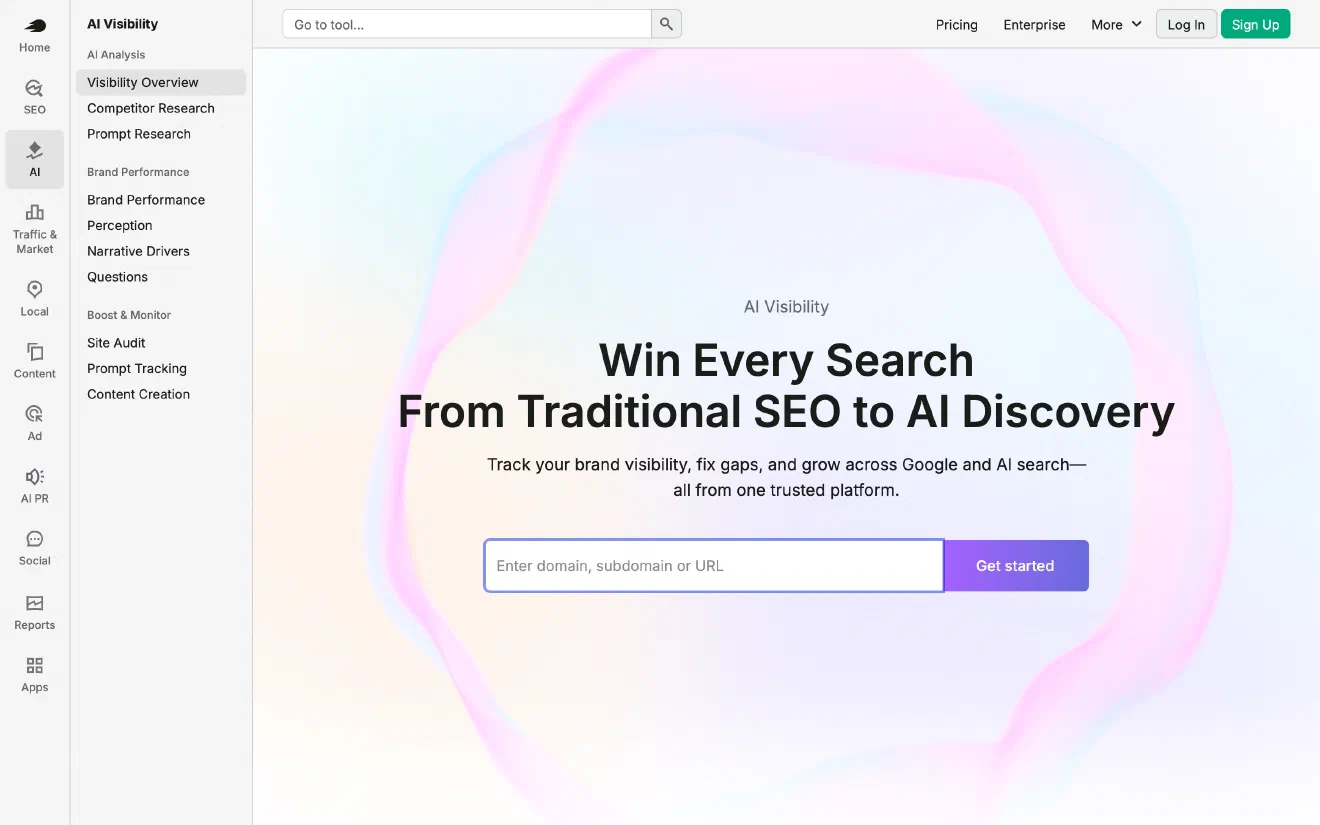
7. Semrush AI Visibility Toolkit #
If you already pay for Semrush, start here. 100 prompts on the AI Visibility Toolkit cost $99 + $60 + $60 = $219 for 125. Semrush One bundles the toolkit with the SEO tools, and its Pro+ plan is $299 a month with 100 prompts.
Coverage is where it gets fiddly. Daily prompt tracking covers ChatGPT Search, AI Mode, AI Overviews and Gemini. Perplexity shows up only in the Brand Performance report, which refreshes weekly (Semrush KB). Semrush says responses are “captured from real requests and not via any APIs of LLMs”. The AI Search Site Audit flags pages that block AI crawlers like OAI-SearchBot and PerplexityBot, which is worth running on its own.
Semrush is now part of Adobe; that deal closed on 28 April 2026. Extra users cost extra, and Semrush’s own pages quote both $45 and $99 a month for one. Pick it if your SEO data already lives in Semrush and 1 login matters more than AI coverage.
- Pros: sits inside your Semrush login, audits pages for blocked AI crawlers, a 317M+ prompt database.
- Cons: Perplexity only in a weekly report, and extra users and domains cost extra.
- Pricing: $99 a month for 25 prompts, plus $60 a month for each 50 more.
8. Ahrefs Brand Radar #
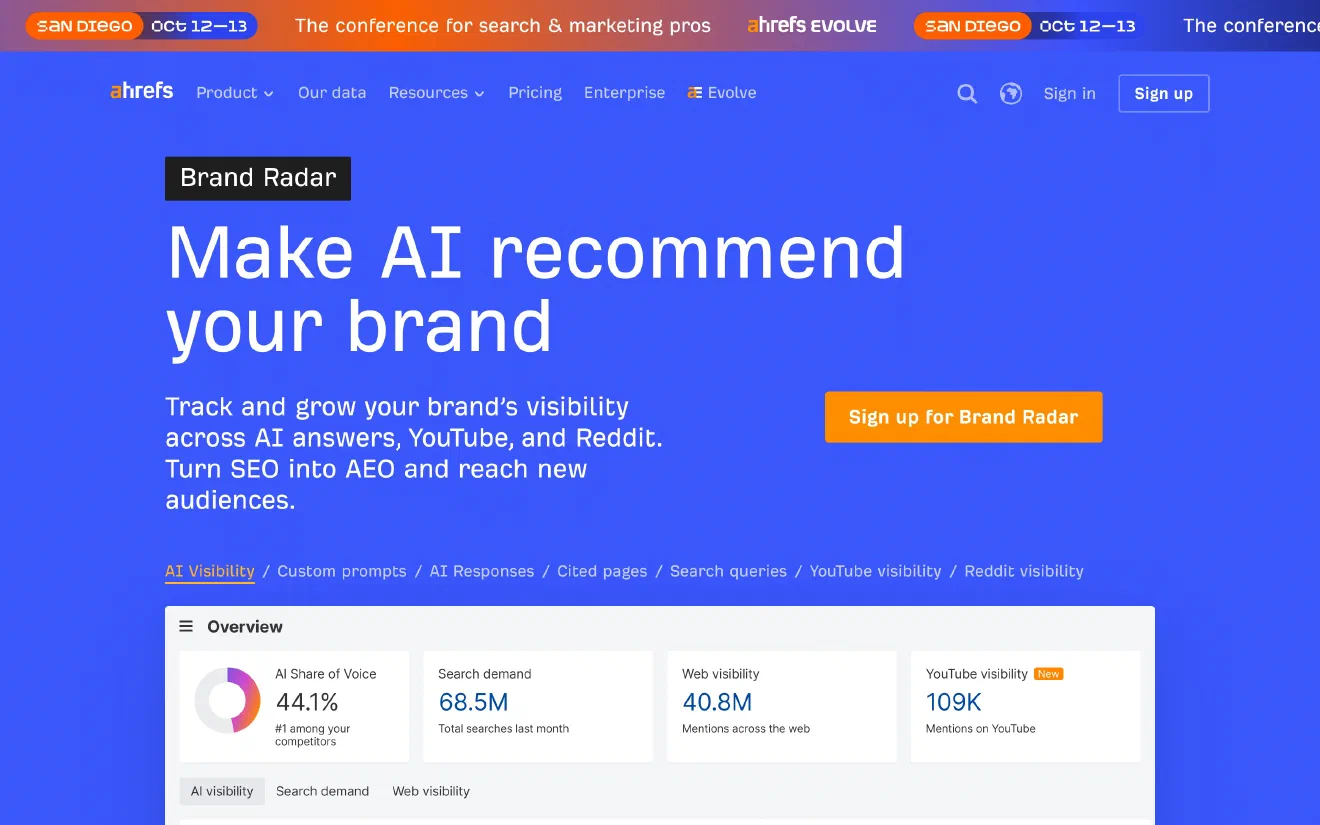
Ahrefs Brand Radar works the other way round from Promptwatch. Instead of starting from your prompts, it starts from an index of hundreds of millions of prompts built from People Also Ask questions and Ahrefs’ keyword data. (The count varies by page: 405M, 451M and 475M.) It shows where any brand appears across AI Overviews, AI Mode, ChatGPT, Perplexity, Gemini and Copilot, collected through the public web interfaces while logged out (methodology). That breadth is the point. You find the prompts you would never have thought to track.
To track your own prompts daily you use custom prompts, metered in checks, where 1 prompt on 1 AI app in 1 location is 1 check. 100 prompts on 4 AI apps, daily, is 12,000 checks a month. Lite ($129) includes 150 and packs cost $100 for 7,000, so by the pricing page’s numbers you would pay about $330 a month. Access to the big AI indexes is a seperate add-on, and Ahrefs’ own pages currently disagree on its price: $199 or $699 a month.
Ahrefs is candid that it does not filter hallucinated links out of its data. Pick it if you already use Ahrefs and want to discover prompts, not only track the ones you wrote.
- Pros: an index of 400M+ prompts to find where you appear, Bot Analytics free in beta.
- Cons: the chatbot index refreshes monthly, daily tracking is metered, and the add-on price is unclear.
- Pricing: needs a paid Ahrefs plan from $129 a month, plus check packs from $50 for 2,500.
9. Scrunch #
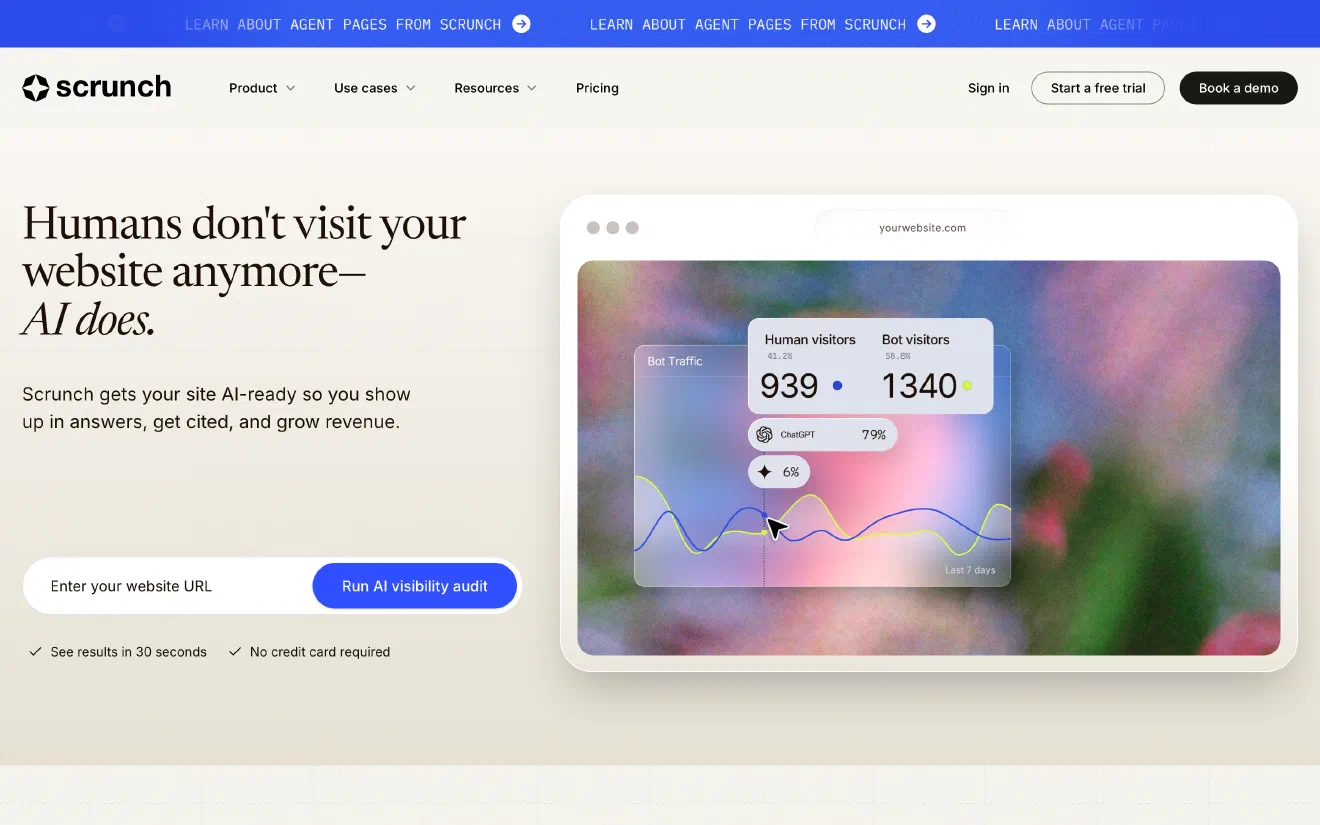
Scrunch sells 1 self-serve plan. Core covers ChatGPT, Perplexity, AI Overviews and Copilot for 1 brand in 1 country. Gemini, Claude, AI Mode, Meta AI and Grok are Enterprise only. It uses “a mix of browser automation and official platform APIs” (FAQ). Prompts run daily for 14 days, then every 72 hours by default.
For 100 daily prompts that means $250, 3 of the 4 AI apps in the setup above, and 5 seats. Check 1 thing before you sign. Scrunch’s help centre says each platform a prompt runs on counts as 1 prompt, which would make 125 prompts closer to 31 across 4 AI apps. The pricing page says “125 unique prompts”.
Sitecore announced it was buying Scrunch in June 2026 (Bloomberg reported $225M). Enterprise adds AXP, which serves AI-optimised versions of your pages to AI agents. It makes most sense if you run Sitecore, or care most about how AI agents read your site.
- Pros: 5 seats on Core, bot traffic tracking and basic content generation included.
- Cons: Core has 4 AI apps and no Gemini, runs every 72 hours after day 14, and prompt counting is unclear.
- Pricing: Core at $250 a month for 125 prompts, Enterprise on request.
10. Profound #
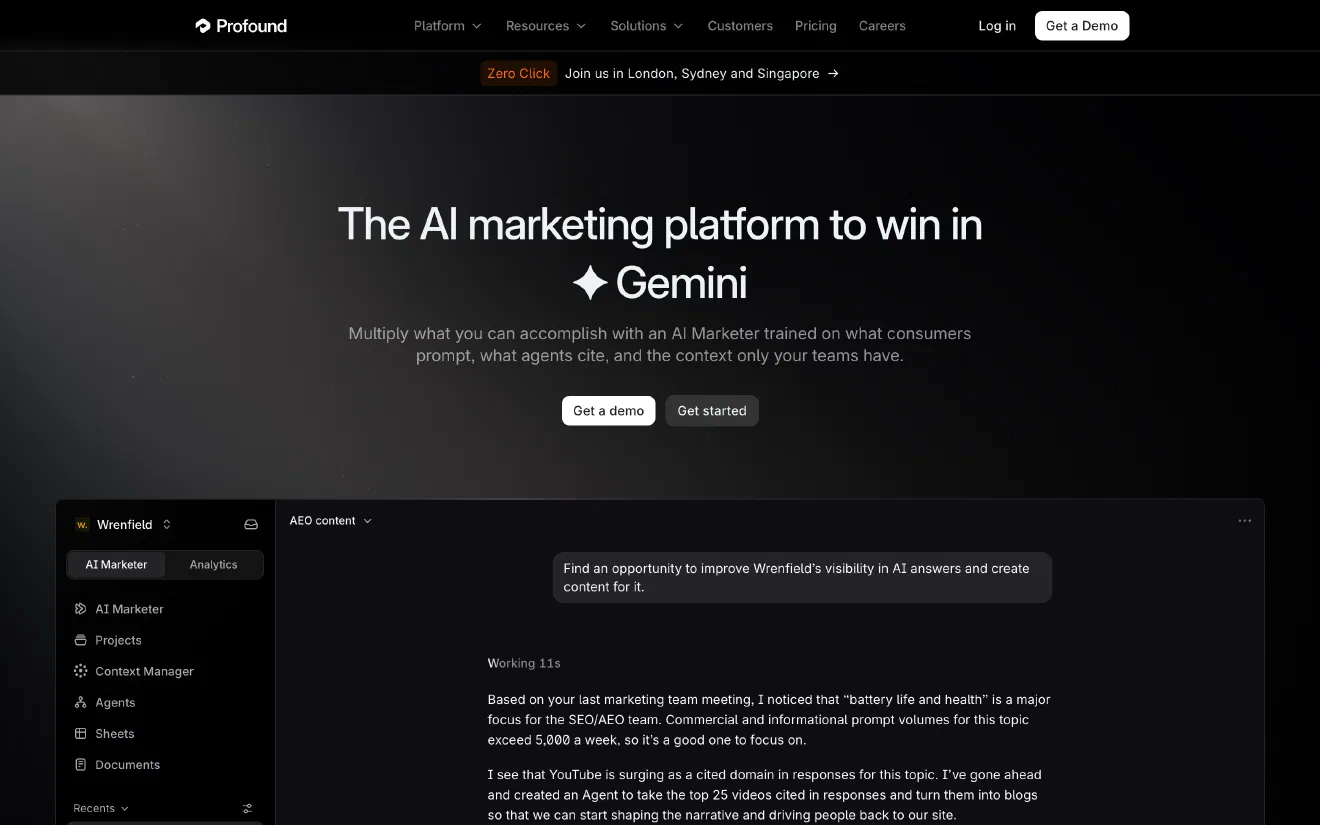
Profound is the heavyweight. It raised $180M at a $1.8B valuation on 15 September 2026 and says it works with over 1,000 enterprise brands (newsroom). The same month it took its public Starter ($99) and Growth ($399) plans off the pricing page. What is left is a free 7-day trial on 50 industry prompts across ChatGPT, Gemini and AI Overviews, and Enterprise. So any setup starts with a sales call.
What you pay for is the data. Profound captures answers from the browser. Its Prompt Volumes feature is built on licensed conversations from “double-opt-in consumer panels”, so it can estimate what people actually ask AI, rather than what they type into Google. Agent Analytics reads server logs from Cloudflare, Fastly, Vercel and others, and checks which crawlers are genuine.
G2 reviewers rate it 4.5 from 1,128 reviews, the largest review base here by a distance. Pick it if you have an enterprise budget and a team that will act on the findings every week.
- Pros: browser capture on up to 9 AI apps, prompt volumes from consumer panel data, crawler analytics.
- Cons: no public paid plan, and the free trial runs a fixed set of industry prompts.
- Pricing: free 7-day trial, then Enterprise at a custom price.
Also worth a look #
A few others did not make the 10 but may fit your case. Evertune asks every prompt 100 times per model and reports share of voice with a stated margin of error, for $800 a month. Its methodology page shows why that matters: 1 run of 1 prompt carries a margin of ±44 points, and 100 runs bring it to ±10. Gauge runs 600 prompts a day on 6 AI apps through logged-out browser sessions for $599 a month, with 5 seats and 18 articles. HubSpot AEO is $50 a month for 25 prompts on ChatGPT, Gemini and Perplexity, and suggests prompts from your CRM data. Writesonic pairs tracking with a large content tool, but its self-serve plans only track ChatGPT, Gemini and AI Overviews. Goodie starts at $399 and is the one to look at if you sell products, since it covers shopping assistants like ChatGPT Shopping and Amazon Rufus.
Which one fits your team #
Start from the reason you are looking. If it is seats, Lumirank, Peec AI and Otterly.AI all give unlimited users and run daily, and run 100 daily prompts on 4 AI apps for $99 to $330 a month. If it is budget, Otterly Lite gets you started at $29, and LLMrefs covers 500 prompts for $79 if weekly data is enough.
If you want more AI apps, Claude and Grok included, look at AthenaHQ and Rankscale. Both bill in credits, so decide on your cadence before you compare prices. If your team already lives in an SEO suite, Semrush and Ahrefs save you a login, at the cost of patchy AI coverage (Semrush) or monthly chatbot data (Ahrefs).
At the enterprise end, Profound gives you the deepest data layer. And if Promptwatch’s Content Agent is the part you use most, the cheaper trackers here will not replace it. Of the 10, Profound writes articles and Scrunch Core includes basic content generation. Outside the 10, Evertune, Gauge and Writesonic do both.
Before you switch, run both for 2 weeks #
Scores do not compare across tools out of the box. Each vendor defines visibility a little differently, collects from different places, and matches brand names its own way. So compare what each tool records for the same prompts, rather than their headline scores.
- Take 20 of the prompts you track. Mix category questions with head-to-head ones against your main rivals.
- Load the same 20 into Promptwatch and the candidate, on the same AI apps and the same country.
- Run both for 14 days. Compare the mention rate per AI app over the whole window, not day by day, becuase single runs vary a lot.
- Each week, run 5 of the prompts yourself in a logged-out browser from the country you target, and see which tool’s record matches what you saw.
- Then price your full job, seats included, on whichever tool matched best.
Lumirank’s free plan tracks 10 prompts daily on 2 of its 6 AI apps, which is enough to keep your spot-check prompts running as a third reading while you decide.