When I ask ChatGPT which payment gateway to use, the answer often feels like it came from a well-read friend. Well, these assistants are trained to sound like they know their stuff. But where does that answer actually come from? Not from memory. Instead of answering from what it learned in training, the model searches the web -> picks the top results -> reads those pages -> thinks about what it read -> answers. The model is only one part of that chain, and I would argue it is not even the part that decides whether your brand is in the running.
In short
- The language model inside ChatGPT or Gemini is a frozen snapshot. Its knowledge stops months before you talk to it.
- So the apps hand the model tools. For a product question it makes at least 2 tool calls: a web search, then a fetch of the pages worth reading.
- Your prompt gets rewritten into several search queries. Ordinary search ranking decides which pages reach the model at all.
- The model reads passages, not whole pages, then weighs them against what it already believed.
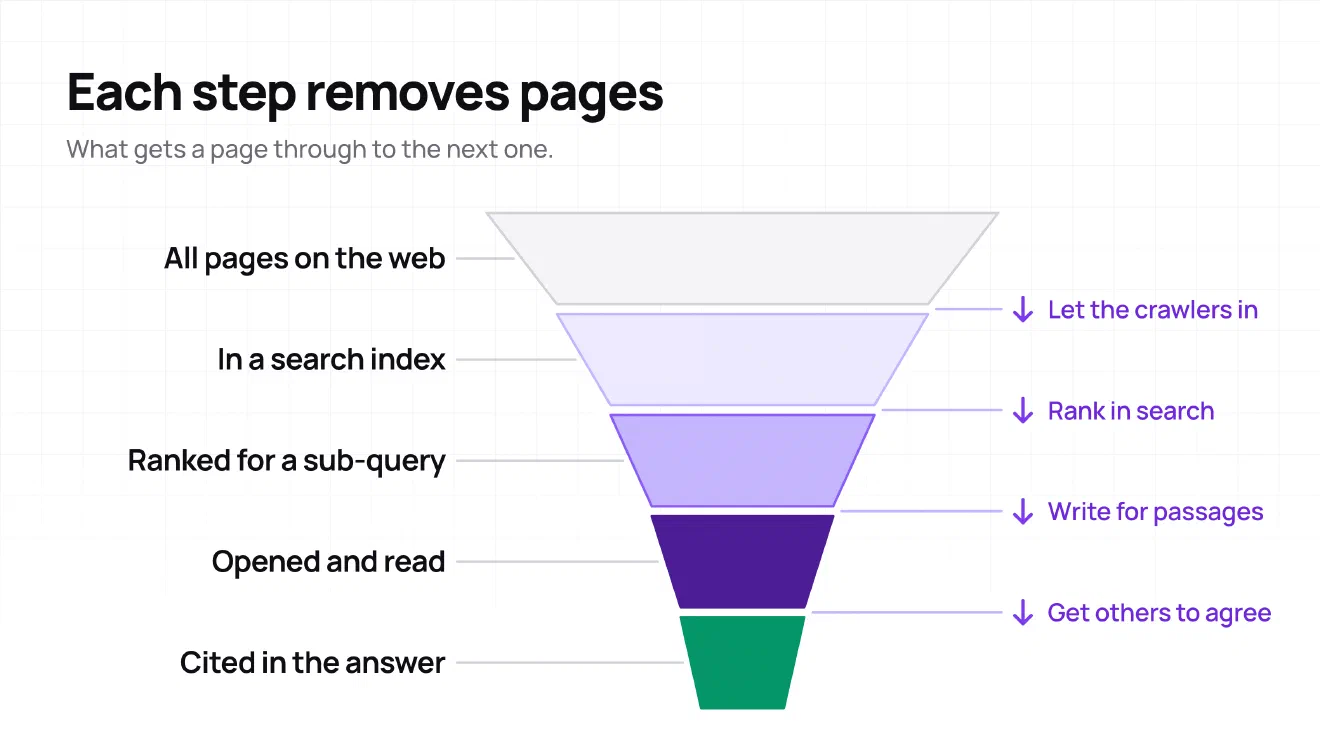
- Every step is a filter. To come out the other end a brand has to be indexed, fetchable, quotable and backed up by other people.
The model on its own cannot know about you #
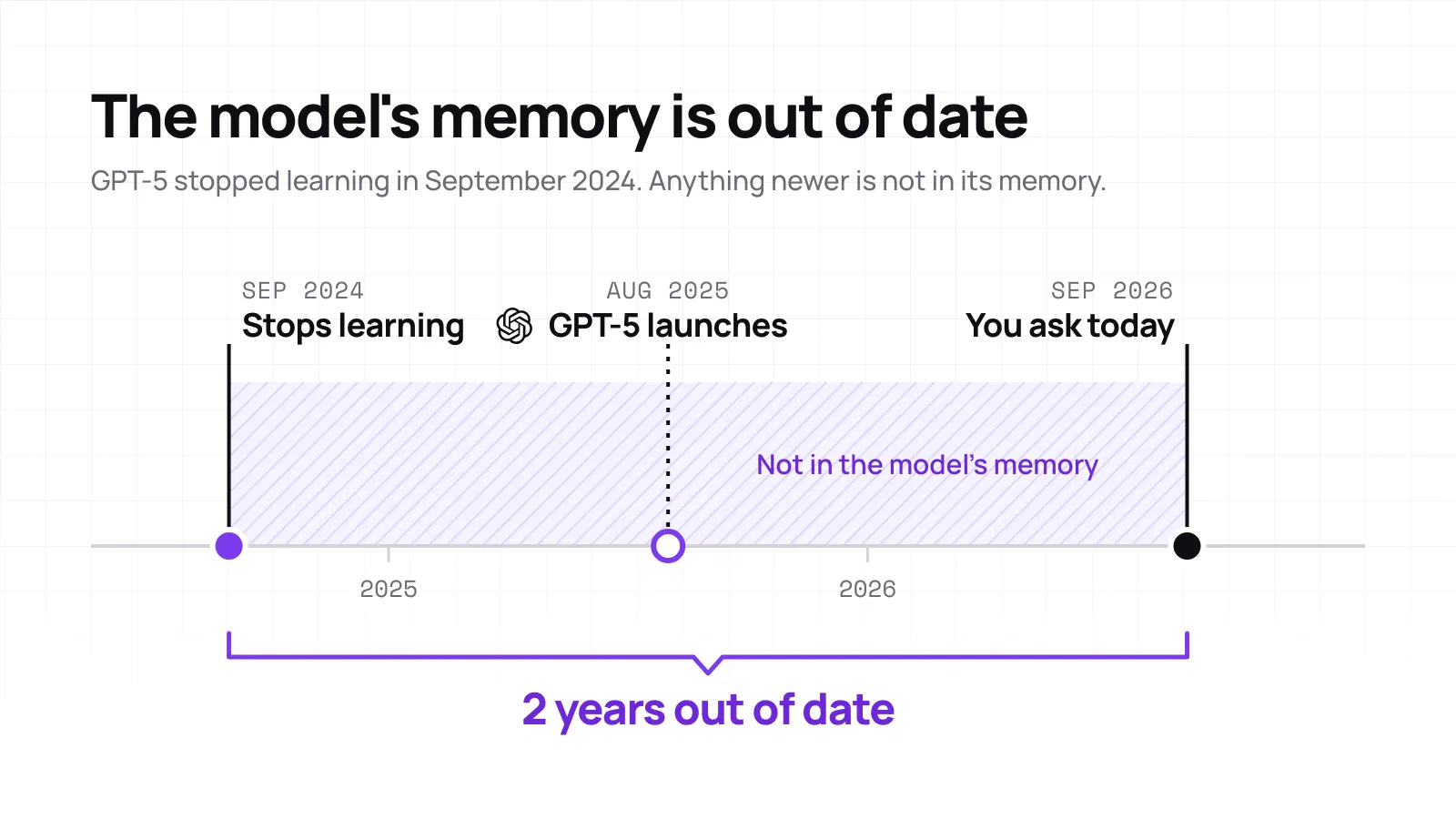
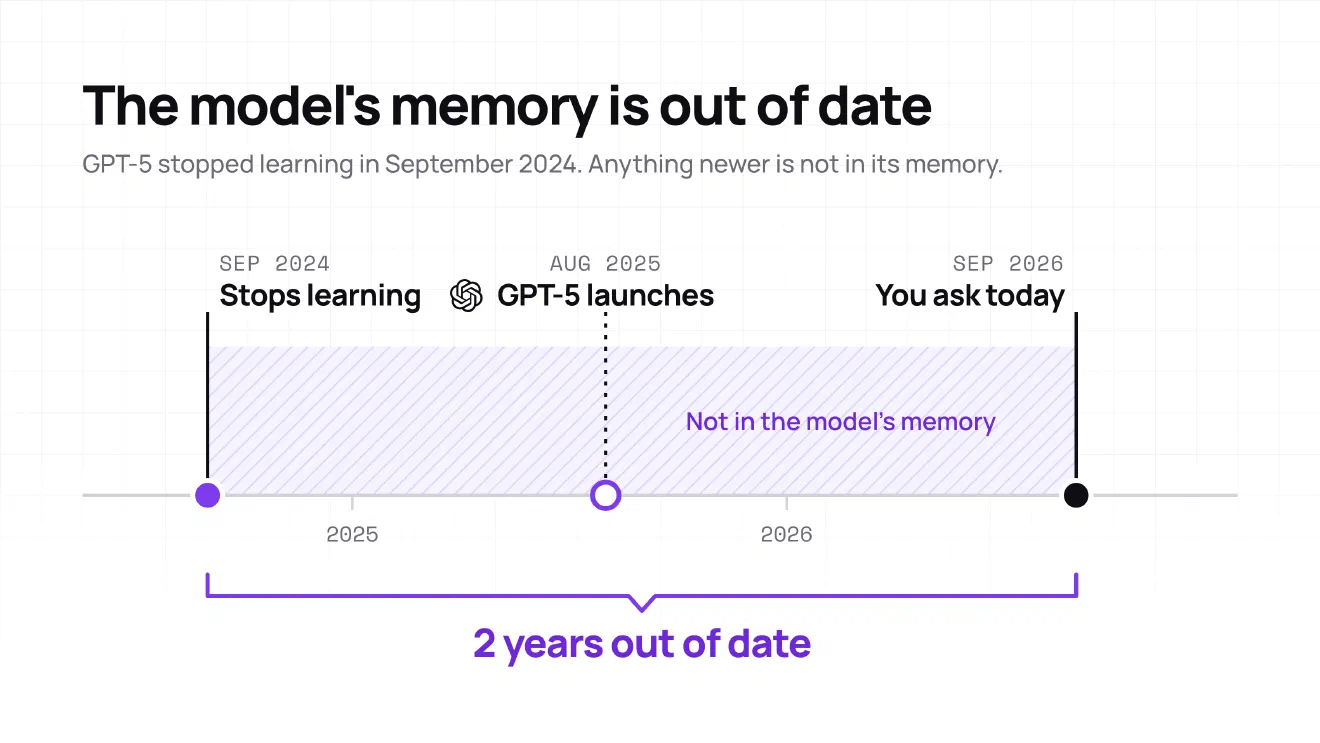
Here is the thing people forget about these models. A large language model is trained in 2 phases. Pretraining feeds it a huge slice of the public web and it learns the patterns in there. Fine-tuning then teaches it to be helpful and to follow instructions. Both phases finish on a date, and after that date the weights do not change. Nothing new gets in.
That date is the knowledge cutoff, and it usually sits further back than people assume. GPT-5 shipped in August 2025 with a cutoff of September 2024. Gemini 2.5 Pro has a January 2025 cutoff. Newer models narrow the gap, but there is always a gap. A model released this month still has no idea about the pricing page you shipped last week.
And there is a second, quieter problem. Even inside the cutoff, what the model holds about your brand is a statistical impression rather than a record. It has seen your name near some words more often than near others. It cannot really tell your 2024 feature set from your 2025 one. If you ask a model with no tools for “the best CRM for a 10 person agency”, you get a confident answer built from patterns that are a year old, and it will not flag that for you.
So the people building these products did the obvious thing. They stopped asking the model to know things and started asking it to look things up.
Tools: the model asks, software answers #
The mechanism is called tool calling, and it is simpler than the name suggests. The model cannot open a web page. All it can do is produce text. So the app gives it a short menu of actions, written in plain language: search the web, open this URL, find this phrase on the page. When the model wants one of those, it writes a small structured request instead of an answer. The app catches that request, runs the real search or fetch, and pastes the result back into the conversation. I think of it as a colleague handing the model a printout.
The model reads the printout, thinks about what it says, and writes the answer. If a page looks worth opening, it asks for that too before it writes.
That is more or less the whole idea. A model that cannot see the internet becomes a model that sends errands and reads what comes back. OpenAI, Google, Perplexity and Anthropic all run some version of this. Google’s developer docs for Gemini lay it out in 5 stages: the model looks at the prompt, decides whether a search would help, writes one or more queries, runs them, then works the results into a response. ChatGPT’s browsing tool does the same job with different plumbing.
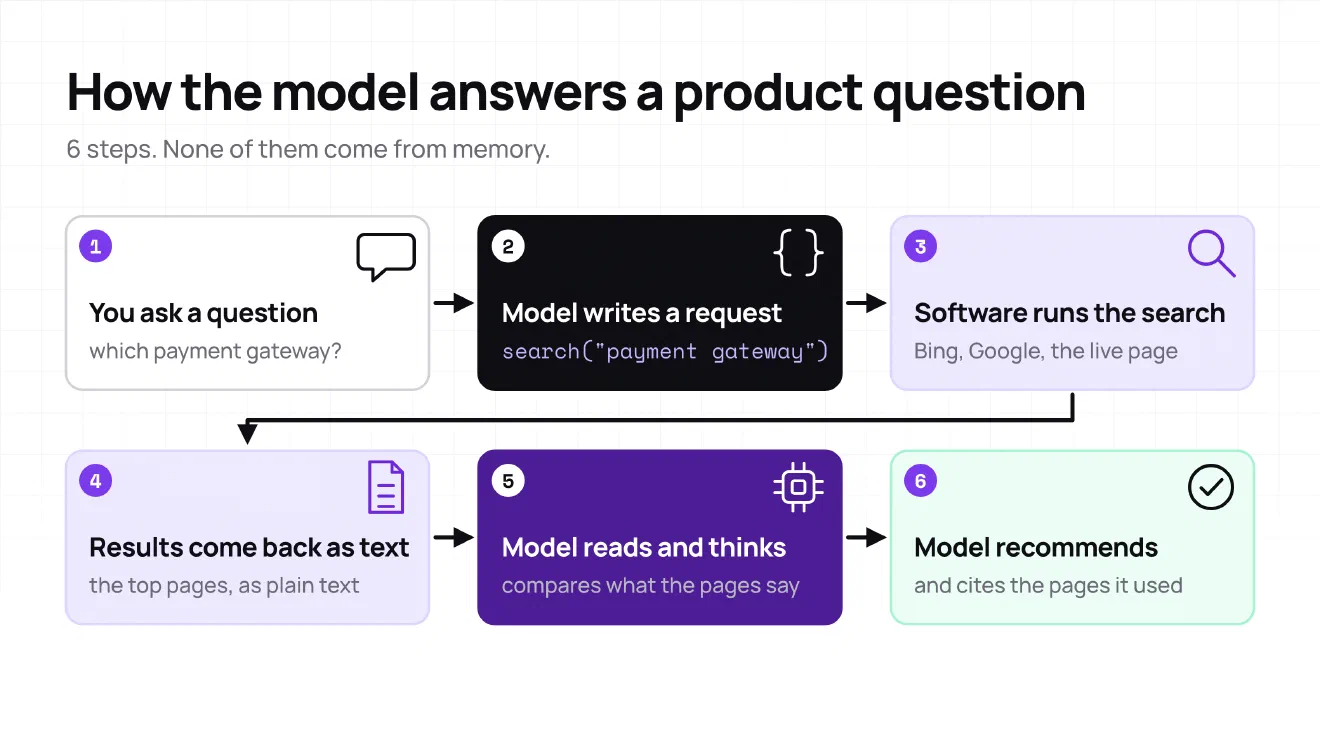
The rest of this post goes through those steps 1 at a time. I want to do it slowly because each step throws pages away, and the pages that survive are the ones that get your brand named.
Step 1: the model decides whether to search #
Not every prompt triggers a search. “Explain compound interest” usually does not. “Best project management tool for a remote team of 12” almost always does, becuase the model has learned that product questions go stale. In ChatGPT there is a small decision layer that makes this call before any search runs. In Gemini the model itself makes it as part of its reasoning.
For a marketer the practical point is short. Anything that names a category, a price, a comparison or the current year goes to the web. Your brand’s fate on that prompt depends on what the web says today, not on what the model absorbed in training. Which is a relief, honestly, because you can change the web.
Step 2: your question becomes several queries #
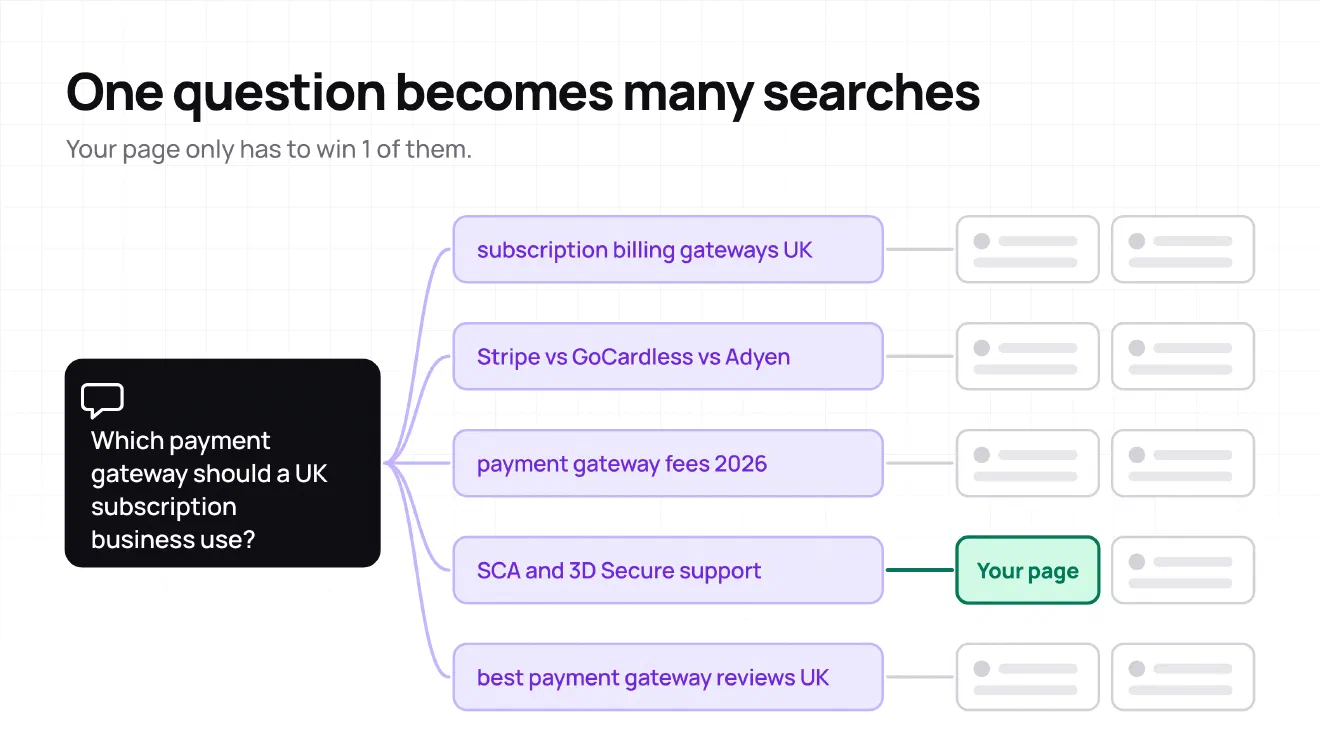
The model does not paste your prompt into a search box. It rewrites it. One question becomes a set of narrower searches, each aimed at one facet of what you asked. Google calls this query fan-out and describes it as “issuing multiple related searches concurrently across subtopics and multiple data sources”. ChatGPT does the same thing, it just has not given it a name.
Take “which payment gateway should a UK subscription business use”. A plausible fan-out looks something like this:
- payment gateways for subscription billing UK
- Stripe vs GoCardless vs Adyen recurring payments
- payment gateway fees comparison 2026
- SCA and 3D Secure support subscription payments
- best payment gateway reviews small business UK
Notice that your page does not need to rank for the original question. It needs to rank for at least 1 of the sub-queries, and the narrow ones are the easier target, because fewer strong pages compete for them.
ChatGPT’s shopping answers go 1 step further. Profound looked at about 200,000 shopping prompts and found a second fan-out layer that turns the prompt into product-specific sub-queries before any candidate is picked. Same pattern, though: many narrow searches rather than 1 broad one.
Step 3: a search engine picks the candidates #
Each of those queries runs against a real search index. For ChatGPT that is a mix of providers with Bing as the main one, plus whatever OpenAI’s own crawler, OAI-SearchBot, has indexed. For Gemini, AI Overviews and AI Mode it is Google’s index, its Knowledge Graph and, for products, its Shopping Graph. Perplexity runs its own index and ranker.
What comes back is a ranked list: title, URL, snippet, date. Not the page, just the listing. The model sees maybe 10 results per query, so the search engine’s ranking decides which pages even exist as far as the model is concerned.
This is where classic SEO still earns its keep. An early study of ChatGPT search found 87% of its citations matched Bing’s top results. The overlap has loosened since, but the principle holds. If no search engine ranks your page for any of the fan-out queries, you were never a candidate.
Two things follow from that, and both catch teams out. Being invisible on Bing now hurts you in ChatGPT in a way it never did in Google. And a robots.txt rule that blocks OAI-SearchBot or Google’s crawler removes you from the pool entirely, however good the page is.
Step 4: the model opens the pages and reads #
Now the second tool call. The model looks at the listings and picks the ones worth opening. For those, the app fetches the live page. OpenAI does this with a seperate fetcher, ChatGPT-User, which only runs when someone’s question needs it. Google reads from its own cache and from the live web.
The model does not read the whole page. Fetched pages get stripped to plain text and the model reads them in passages, looking for the bit that answers the sub-query it is working on, then moves on. A 3,000 word page contributes the 2 paragraphs that match. If they match.
I find this changes how I think about writing a page:
- A claim buried in the 4th paragraph of a section is easy to miss. The same claim in the first sentence under a clear heading is easy to lift.
- A sentence that only makes sense with the paragraph around it cannot be quoted on its own. “Fees start at 1.4% plus 20p per transaction” can. “Our fees are competitive” cannot.
- Pages that only render their main content after JavaScript runs often come back nearly empty to the fetcher. Worth checking yours.
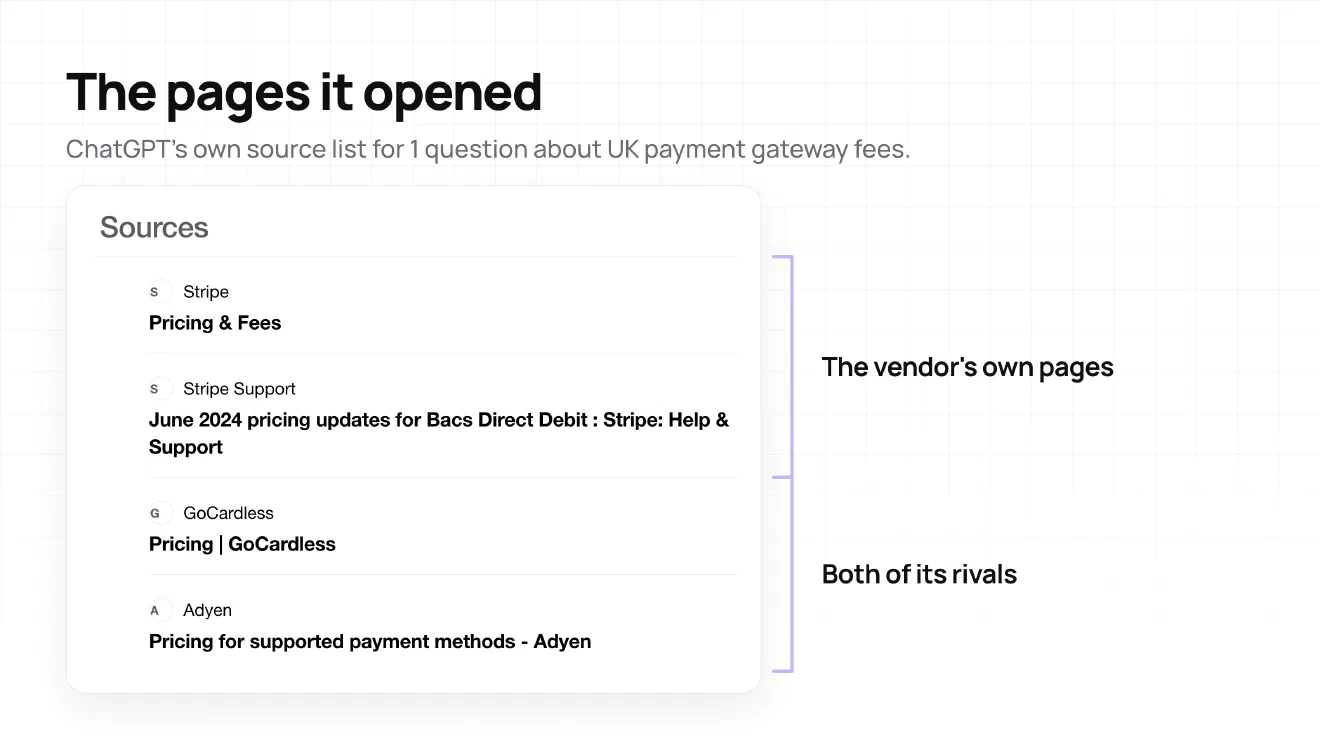
You can watch this step happen, by the way. In ChatGPT, expand the “Searched the web” line above an answer and you see the queries it ran and the pages it opened. Gemini shows the same in its sources panel. Doing this for your own category is the fastest education in GEO I know of.
Step 5: the model reasons over what it read #
With a stack of passages in front of it, the model does what it is actually good at. It compares them. It notices when 4 independent pages make the same claim and when only 1 does. It weighs a vendor’s own page against a review site against a Reddit thread. And it blends all that with what it already believed from training, which still counts. A brand the model has seen a thousand times starts with a prior in its favour, and I do not think there is any way around that except to be seen more.
Newer reasoning models make this step longer and more deliberate. They plan, search, read, notice a gap, search again. GPT-5 Thinking, Gemini’s Deep Research and Perplexity’s Pro Search all run several rounds before writing. The number of tool calls behind 1 answer can run into the dozens.
What survives this stage is usually not the loudest page. It is the claim that is specific, that can be checked, and that other sources repeat. Vague positioning gets a brand listed. A number, a named feature and a third party saying the same thing get it listed first.
There is data for this. In Profound’s shopping study, the product in the top slot had a median of 787 reviews against 352 for the rest. Nobody told the model to count reviews. It reads a review count as other people agreeing, and acts on it.
Step 6: the model writes, and cites #
Finally it writes a conversational answer and attaches citations. Those citations are the pages that made it through all 5 steps: ranked by a search engine, chosen for opening, read, and found useful. They are the audit trail of the whole process, and I read them that way.
A citation is also the only link a reader might click, and very few do. Pew tracked 900 US adults and found people clicked a source inside an AI Overview on about 1% of visits. So being cited matters because it means you were in the answer, not because it sends you traffic. It mostly does not.
Why people trust these answers #
Put the steps together and what comes out is a synthesis of 10 to 30 pages, cross-checked, with the disagreements smoothed over and a recommendation on top. That is a better first draft of a decision than a page of blue links, and people behave accordingly.
The same Pew study found that when an AI summary appears, people click a traditional result on 8% of searches, against 15% when there is no summary. ChatGPT passed 900 million weekly users in February 2026 and kept growing. Google’s AI Mode, built on exactly these steps, is now how a large share of searchers meet a product category for the first time.
None of that means the answers are always right. The process inherits whatever the top search results say, and the top results for a commercial query are not exactly neutral. But the answers are consistent, they are confident, and they arrive in 1 place, and that turns out to be enough to move where the decision gets made. OpenAI’s own retreat from in-chat checkout in March 2026 shows the shape of it: people decide in the chat and buy on the site.
Which pages survive the steps #
Step back and the steps are a series of filters, each one removing pages. What the studies say about the survivors is roughly this.
Sources are concentrated, and they move. Semrush tracked 230,000 prompts over 13 weeks and watched Reddit’s share of ChatGPT citations fall from about 60% to about 10% in a single quarter, while PR Newswire, Forbes and Medium rose. The set of trusted sources per category is small and it does not sit still. Whatever the model cited last month is not a safe bet for next month.
Each engine has its own habits. In the same period Google’s AI Mode leaned on LinkedIn, YouTube and Reddit, and cited Wikipedia in around 2% of answers. ChatGPT cited Wikipedia far more. Being visible in 1 engine tells you little about the others, because the search index behind each one is different.
Fresh, specific pages beat broad, old ones. The fetcher reads passages, so a focused page that answers 1 sub-query head-on tends to beat a general page that mentions the topic in passing. And recency is right there in the listing the model sees, so it uses it.
Third parties carry more weight than you do. Your own page tells the model what you claim. A review site, a forum thread or a comparison article tells it whether anyone agrees. The model treats agreement as evidence, which, to be fair, is what most of us do too.
If I had to put the work in order, the steps themselves dictate it:
- Be in the index. Google’s and Bing’s. Let OAI-SearchBot and ChatGPT-User through.
- Be readable. Server-rendered text, clear headings, 1 claim per sentence, numbers where numbers exist.
- Be backed up. Get the same specific claims onto pages you do not own.
- Be measured. Run the prompts your buyers ask, weekly, on every engine you care about, and log which pages got cited and where your brand landed in the list.
The 4th one is the step most teams skip, and it is the only one that tells you whether the first 3 worked. Doing it by hand for 20 prompts across 4 engines takes me about an afternoon a week. Lumirank exists to turn that into a dashboard, but I would still do the manual version once. Open ChatGPT, ask the question a buyer would ask, expand the search panel, and read the list of pages it chose. Everything in this post is visible in that list.