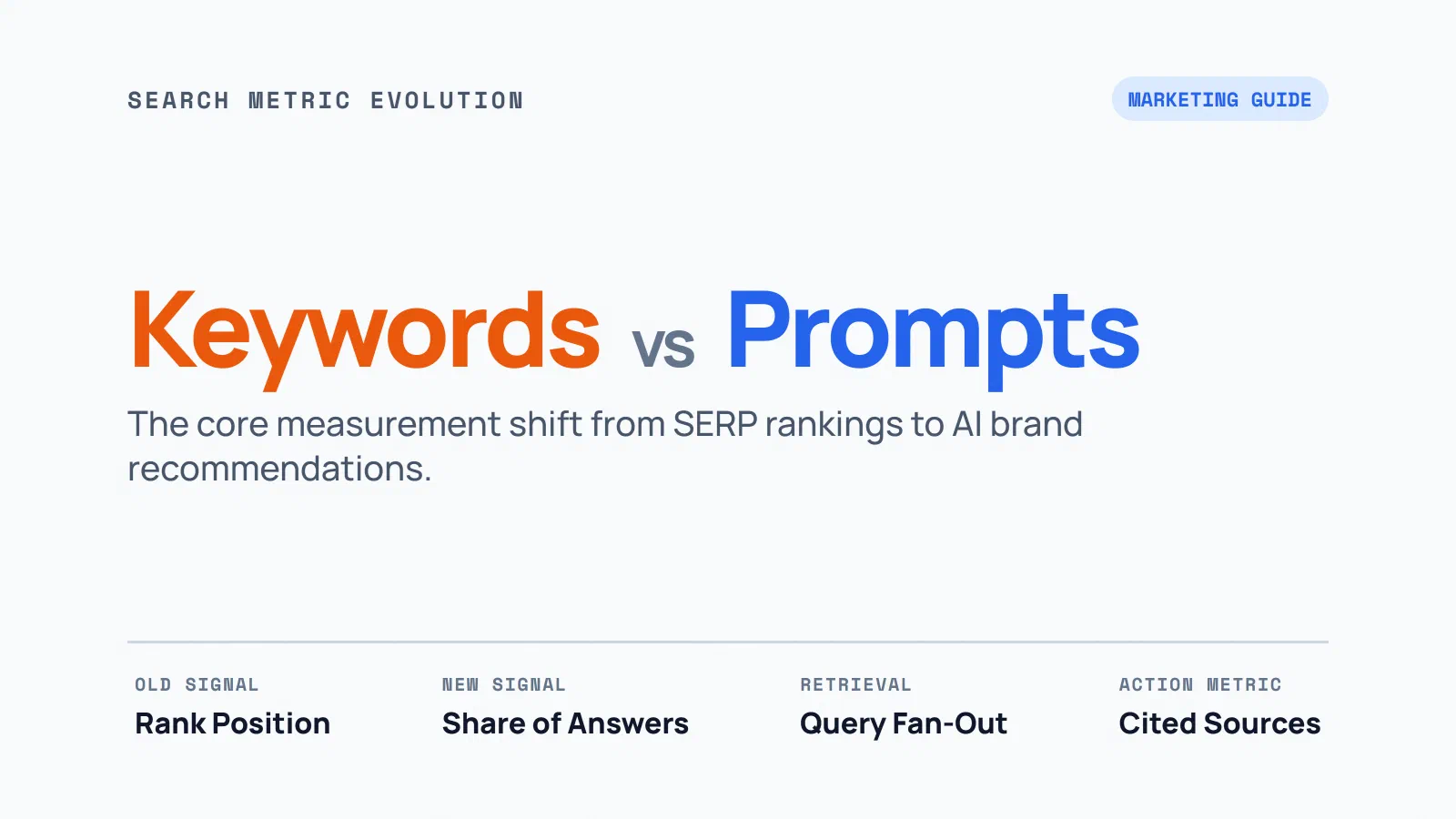
For twenty years, organic search measurement meant tracking whether your page ranked in the top ten links for a keyword. Generative AI tools like ChatGPT, Perplexity, Gemini, and Google AI Overviews change that setup. Buyers now submit multi-sentence prompts with specific constraints, and AI engines synthesize answers instead of listing links. Marketing directors must now measure both traditional keyword rankings and AI prompt visibility.
In short
- Keywords target ranked links, while prompts request evaluated solutions. Keywords are search phrases. Prompts ask an AI to evaluate trade-offs and name specific brands.
- AI models do not rank sites in fixed positions. Language models generate answers probabilistically, meaning identical prompts can return different brand recommendations across runs.
- Prompt tracking measures share of answers and cited sources. Instead of checking position numbers, teams track recommendation frequency, competitor mentions, and external citations.
- Prompts do not replace keywords. AI engines use traditional search indexes behind the scenes. Strong technical SEO and keyword discoverability feed AI citations.
What Keywords and AI Prompts Are #
In traditional search, a keyword is a concise phrase of two to four words, such as “ecommerce customer service software”. It represents intent without context. Google matches those words against indexed page titles, headings, and backlinks to return a ranked list of links.
An AI prompt is different. A prompt is a conversational scenario with explicit requirements: “We run three Shopify stores with 15 agents, use Klaviyo, and need helpdesk software with flat monthly pricing. Which tools should we evaluate?”
A keyword retrieves documents. A prompt asks an AI model to evaluate criteria and synthesize an answer.
How Keyword Tracking Differs From Prompt Tracking #
Because keywords and prompts operate differently, tracking them requires distinct metrics.
Keyword tracking is deterministic. For a given location, search results remain stable. Success is measured by rank position (1 through 10), search volume, and click-through rate.
Prompt tracking is probabilistic. Models like GPT-4o, Claude, and Gemini generate text by predicting tokens based on probability weights. Testing the same prompt five times often returns different brand recommendations.
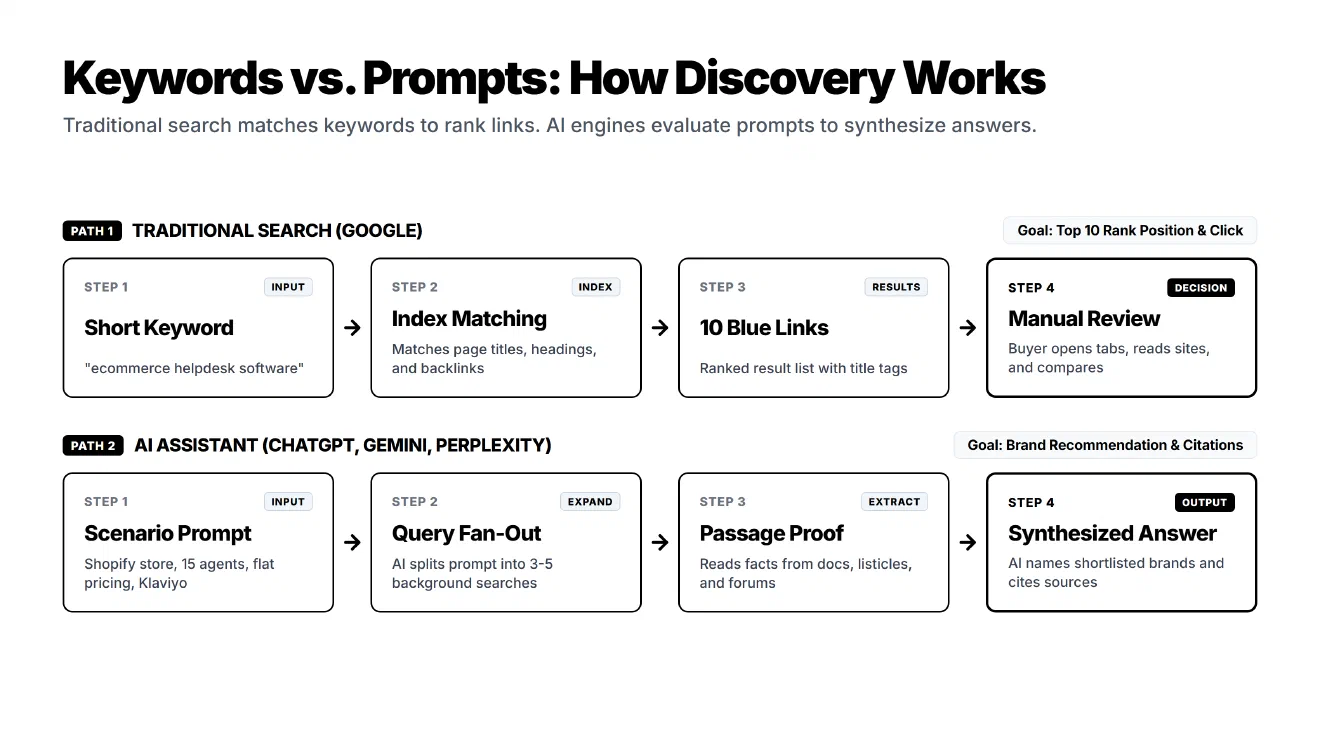
Furthermore, AI engines do not search for a prompt as a single string. Under Google Search Central documentation on AI Overviews, engines use query fan-out: splitting a prompt into several background searches, fetching candidate pages, extracting factual passages, and synthesizing an answer.
Because answers vary dynamically, marketing directors cannot track a single ranking number. Visibility must be tracked statistically as a share of answers across repeated runs over time.
A Practical Example: One Customer Need, Two Search Modes #
Consider OmniDesk, a fictional B2B customer support platform for ecommerce brands. OmniDesk provides flat pricing of $199 monthly for 20 agents, multi-store Shopify routing, and Klaviyo integration.
Suppose an ecommerce director needs to replace their ticketing system.
On Google Search, the buyer types:
shopify multi store customer service tool
Google returns ten links: OmniDesk’s product page, three competitors, and review directories like G2. OmniDesk ranks at position 3 and earns search clicks.
In ChatGPT or Perplexity, that buyer enters a detailed prompt:
We run three Shopify storefronts with 15 support agents. We use Klaviyo and need a helpdesk with multi-store ticket routing and flat monthly pricing with no per-ticket fees. Which tools should we consider?
The AI assistant executes three seperate searches behind the scenes:
- Shopify multi store helpdesk ticket routing
- ecommerce helpdesk Klaviyo integration
- customer support software flat pricing no per-ticket fees
The AI reads passages across review guides, excludes tools charging per-ticket fees, and names three platforms.
If OmniDesk hides flat pricing behind a sales demo form, the AI crawler cannot verify the cost. The AI recommends competitors whose pricing is visible in plain HTML on public review sites. OmniDesk wins the keyword search, but loses the AI recommendation.
What Prompt Metrics Tell Marketing Teams #
To measure AI discovery, marketing teams track four core metrics:
- Share of Answers: The percentage of test runs where an AI model recommends your brand. If a model runs your prompt 30 times and names your brand 18 times, your share of answers is 60%.
- Brand Prominence: Whether you are named as the primary recommendation or a secondary option, and how accurately the AI describes your features.
- Competitor Mentions: Which rivals appear in the same prompts, revealing which specific constraints trigger competitor recommendations.
- Cited Sources: The exact URLs the AI references to ground its claims, including third-party roundups, documentation, and forums.
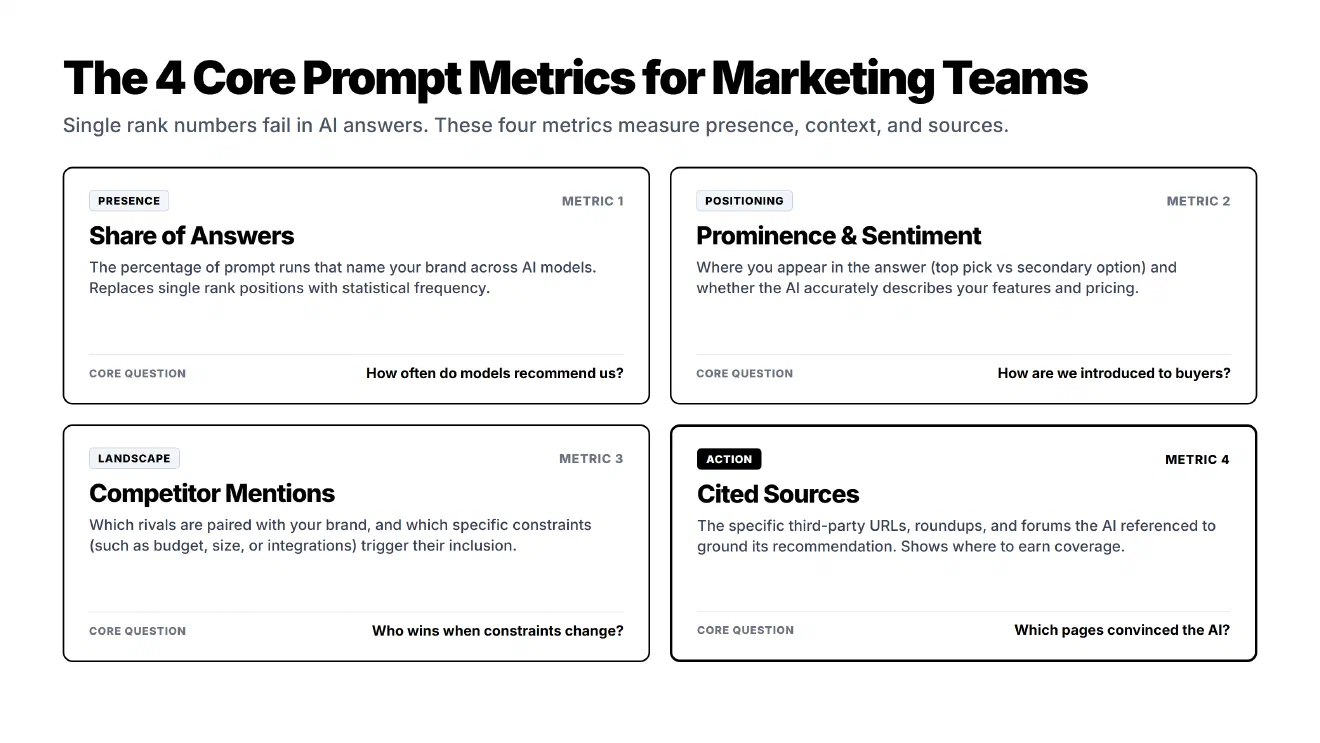
Cited sources are the most actionable signal. If an AI recommends a competitor, inspecting citations shows which comparison articles omit your product. Earning coverage on those cited domains directly influences future model answers, becuase engines refresh their grounding indices regularly.
Why Prompts Do Not Replace Keywords #
Prompts do not make traditional SEO obsolete. Both metrics are needed.
First, AI engines rely directly on search indexes. As documented by OpenAI regarding OAI-SearchBot, search assistants query indexes like Bing and Google to retrieve source pages. If your pages have crawl errors or fail to rank for technical sub-queries, AI models cannot find or cite them.
Second, search behavior differs by intent. Buyers use short keywords for navigation and direct purchases. A user searching for “OmniDesk login” uses a keyword, not a prompt.
Tracking keywords measures website discoverability. Tracking prompts measures brand recommendation rate. Measuring both ensures you capture direct search traffic while securing inclusion in AI answers. See our guide on Traditional SEO vs GEO and AEO for more on how these search layers interact.
How to Start Tracking Prompts and Improving Content #
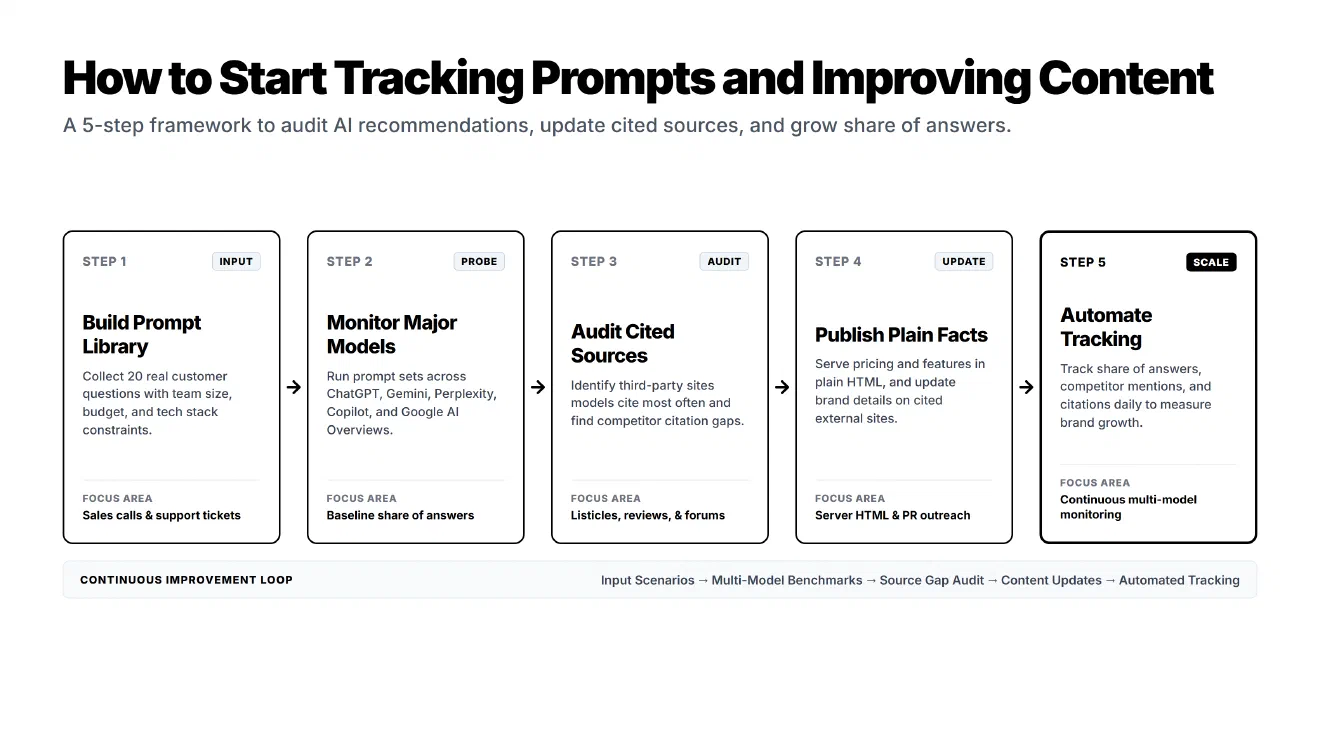
Marketing directors can implement prompt tracking with five practical steps:
- Build a prompt library. Collect 20 customer questions from sales calls and support tickets. Include team size, budget, and tech stack constraints.
- Monitor across major models. Test prompts weekly across ChatGPT, Gemini, Perplexity, Copilot, and Google AI Overviews to measure baseline share of answers.
- Audit cited third-party domains. Identify the sites models cite most often in your category. Focus outreach on updating your brand details in those roundups.
- Publish clear facts in plain HTML. AI crawlers rarely execute client JavaScript. Serve pricing and integration details in plain HTML. See our guides on how generative engines choose brands and 5 steps to improve your AI rank for technical rules.
- Automate tracking. Testing dozens of prompts manually is slow. Platforms like Lumirank automate daily testing across six AI engines, tracking share of answers, competitor mentions, and citations.
Actionable Checklist for Marketing Directors #
Use this checklist to audit your team’s readiness for prompt tracking:
- Track keyword ranks for navigational and high-intent searches.
- Build a library of 20 customer scenario prompts with real constraints.
- Allow OAI-SearchBot, PerplexityBot, and Googlebot in robots.txt.
- Serve pricing and feature details in plain HTML without JavaScript.
- Check top third-party sources cited by AI models and verify brand accuracy.
- Track weekly share of answers and competitor mentions across AI platforms.
Frequently Asked Questions #
Are AI prompts replacing SEO keywords completely? #
No. AI search engines still query traditional search indexes to retrieve web pages before generating an answer. Traditional keywords remain essential for direct search traffic and technical indexation.
Can a marketing team guarantee a top recommendation in AI answers? #
No. Generative models produce answers probabilistically, meaning identical prompts can yield varying brand recommendations. Marketing teams track share of answers over repeated runs rather than expecting a fixed rank.
What is the most actionable metric to track in AI prompt responses? #
Cited sources. Tracking which third-party articles, reviews, and forums AI models cite shows exactly where your brand needs updated coverage to earn recommendations.