Consider an operations manager at a 40-person architecture firm in Chicago looking for billable time-tracking software. A few years ago, they would search Google for “time tracking software architecture firm” and click through several blue links to compare options across browser tabs. Today, that manager often asks ChatGPT, Perplexity, or Google’s AI Mode a complete question: “What is the best time tracking software for a 40-person architecture firm that connects with QuickBooks Online?”
Instead of returning ten links, the AI system runs several background searches at once, pulls candidate pages, extracts factual passages, checks for agreement across independent websites, and writes an answer naming four products. Traditional Search Engine Optimization (SEO) works to earn a click from a list of links. Answer Engine Optimization (AEO) and Generative Engine Optimization (GEO) work to get your brand recommended directly inside that written answer.
In short
- SEO targets clicks on a results page, while GEO and AEO target mentions inside the answer. In a study by Pew Research, Google users clicked a traditional result link on 8% of visits when an AI summary appeared, down from 15% without one. Visitors clicked a citation link inside the AI summary only 1% of the time.
- AI apps split one question into multiple narrow searches across different indexes. Only 12% of the pages cited by AI assistants rank in Google’s top ten for the user’s original prompt, and ChatGPT and Microsoft Copilot rely heavily on Bing.
- AI search bots need explicit permissions and plain HTML. Blocking bots like OAI-SearchBot or PerplexityBot removes you from AI answers. Unlike Googlebot, major AI crawlers do not run JavaScript to render text.
- AI models extract self-contained facts rather than evaluating whole pages by keyword density. Adding specific statistics and direct quotes lifted visibility by 31% to 41% in the Princeton GEO study, while repeating keywords reduced visibility by 8%.
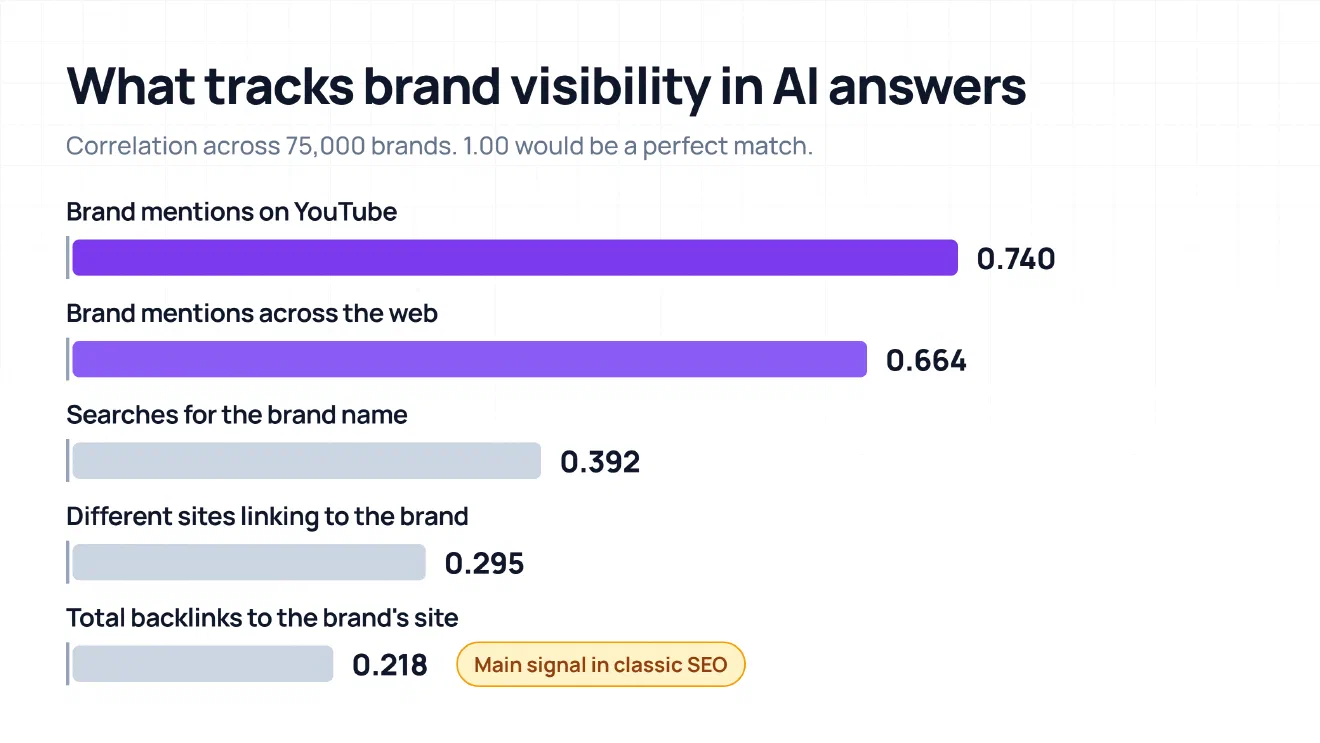
- Brand mentions carry much more weight than backlinks in AI answers. Across 75,000 brands studied by Ahrefs, brand mentions on independent websites tracked AI visibility three times as closely as domain backlinks.
The Core Differences Between SEO, AEO, and GEO #
Marketing teams use three different acronyms to describe search visibility today. Each one represents a distinct layer of how software finds and presents information:
- Traditional Search Engine Optimization (SEO) helps a web page rank near the top of a classic search engine results page, such as Google or Bing. The goal is to earn a high ranking so a person clicks your link and visits your website.
- Answer Engine Optimization (AEO) organizes facts on your page so search engines and voice assistants can extract a direct answer. It began with featured snippets and voice queries on Siri and Alexa, and now powers answers in Perplexity, Google AI Overviews, and Microsoft Copilot. AEO focuses on clear sentence structures that remain meaningful when quoted out of context.
- Generative Engine Optimization (GEO) was defined in a research paper by computer scientists from Princeton University and collaborating institutions. It covers the broader process of getting your brand recommended and cited when an AI assistant gathers information from multiple websites and writes a synthesized response.
In everyday practice, AEO and GEO work together. AEO shapes how you format facts on your own site so an AI can quote you accurately. GEO addresses the wider ecosystem that leads an AI to recommend your brand, including search index coverage, bot access, and what third-party review sites say about you.
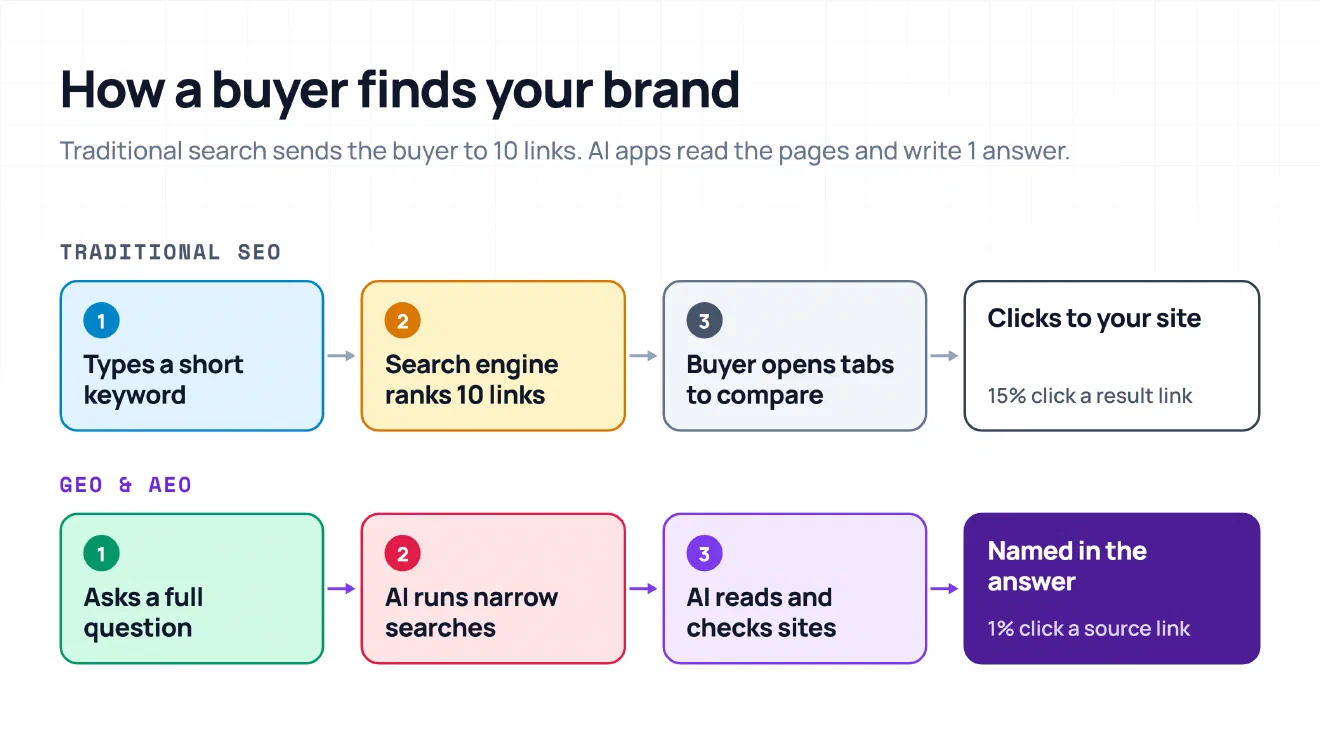
To see how these differences work in practice, suppose you lead marketing for BeaconTime, a project time-tracking tool built for architecture and engineering firms. Your goal is to get the Chicago operations manager to put BeaconTime on their shortlist. Looking at how BeaconTime appears in classic search versus an AI answer highlights why traditional SEO is no longer enough on its own.
How Single Keywords Compare to AI Query Fan-Out #
In traditional SEO, you start by researching the exact phrase buyers type into Google. For BeaconTime, that primary keyword might be “time tracking software for architects”. You build a landing page for that phrase, work to rank in Google’s top three results, and wait for visitors to click.
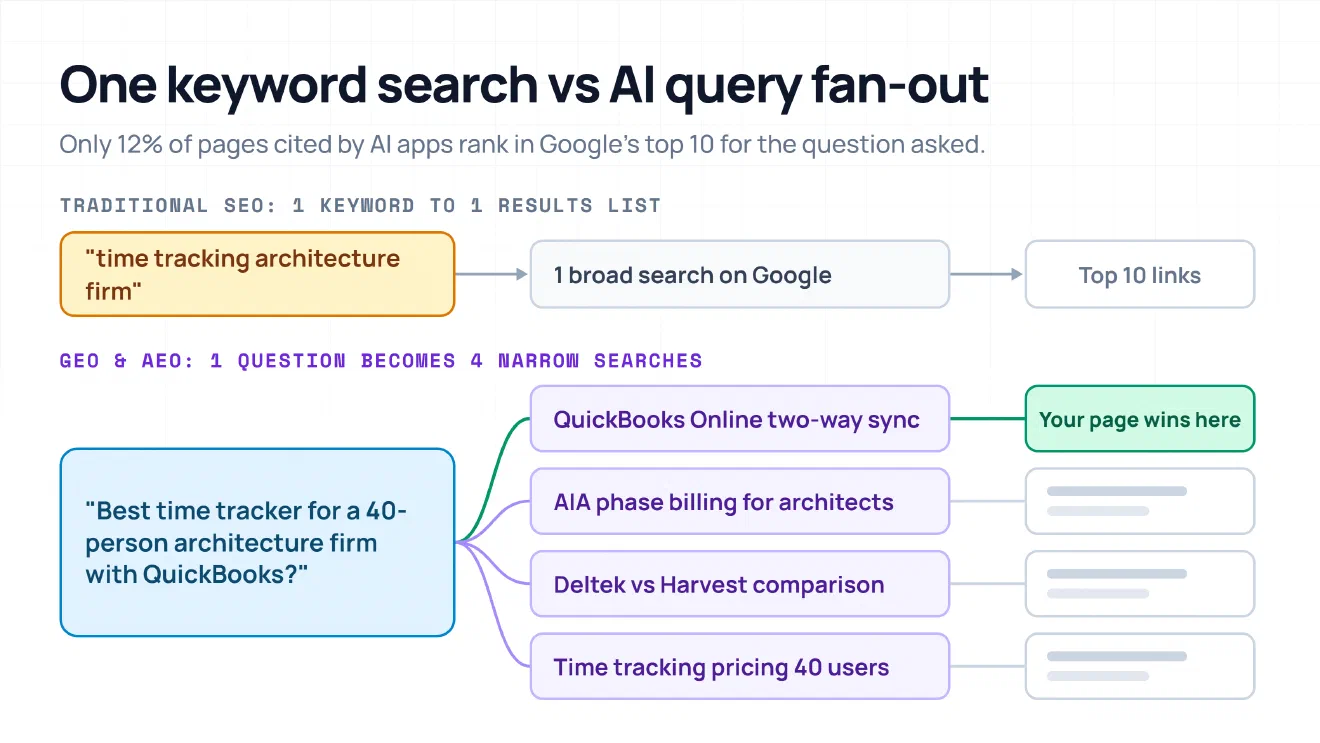
When that buyer asks an AI assistant for “the best time tracking software for a 40-person architecture firm that connects with QuickBooks Online”, the discovery process changes in two fundamental ways.
First, the AI does not search for that long sentence as a single phrase. Instead, it breaks the prompt into several specific sub-searches and runs them in parallel. Google describes this process as query fan-out. For the Chicago manager’s question, an AI assistant might run four separate searches behind the scenes:
- time tracking software for architecture firms
- time tracking app two-way sync QuickBooks Online
- AIA phase billing software for architects
- project time tracking pricing 40 users
Because the AI pulls pages from all of these sub-searches, your site does not need to rank in the top ten for the broad prompt to earn a citation. In an Ahrefs study of 15,000 prompts across major AI assistants, only 12% of cited pages ranked in Google’s top ten for the original user query. In ChatGPT, that overlap was just 8%. Even in Google’s AI Overviews, Ahrefs found that the share of citations coming from Google’s top ten organic results dropped to roughly 38% after Google introduced Gemini 3.
Second, AI assistants rely on different search engines to find sources:
- Google AI Overviews, Google AI Mode, and Gemini search Google’s index.
- ChatGPT uses outside search providers alongside its own web crawler. OpenAI documentation notes that ChatGPT searches Bing, and an analysis by Seer Interactive found that 87% of early ChatGPT citations matched Bing results.
- Microsoft Copilot runs directly on Bing.
- Perplexity maintains its own search index using PerplexityBot.
- Claude retrieves web information partly through Brave Search.
For BeaconTime, this changes where marketing effort belongs. If BeaconTime ranks well on Google for its broad keyword but has an outdated sitemap on Bing and no clear page explaining its QuickBooks Online sync, ChatGPT and Copilot may overlook it. Verifying your site in Bing Webmaster Tools and enabling IndexNow, which alerts Bing whenever pages update, is now a routine requirement.
How AI Crawlers Read Pages Differently Than Googlebot #
In traditional SEO, technical crawling centers on Googlebot. Google spent years building a rendering engine based on Chrome, allowing Googlebot to load a page, execute its JavaScript files, and index content that renders in the browser.
AI assistants handle crawling under different rules. Major AI companies use seperate bots for model training and live search retrieval. Many website owners blocked all AI bots to protect their content from training, inadvertently removing their pages from AI search results as well:
- OpenAI uses
GPTBotto gather training data andOAI-SearchBotto index pages for search answers. OpenAI documentation confirms that disallowingOAI-SearchBotprevents a site from appearing in ChatGPT search results. A third bot,ChatGPT-User, fetches pages when a user submits a prompt. - Anthropic uses
ClaudeBotfor training andClaude-SearchBotfor search retrieval. - Perplexity uses
PerplexityBotexclusively to index web pages for search. - Google uses
Googlebotfor both organic search and AI Overviews, while offering a Search generative AI control in Search Console to manage AI inclusion. A separate token,Google-Extended, manages access for Gemini training.
Even when your robots.txt and CDN rules allow search bots, another technical constraint applies. An analysis by Vercel and MERJ across billions of crawler requests found that none of the major AI search crawlers currently render JavaScript.
This creates an immediate risk for modern web applications. Suppose BeaconTime calculates pricing for 40 users through a client-side React slider, and loads its QuickBooks feature table through a browser script. A human visitor and Googlebot see that BeaconTime costs $12 per user monthly with two-way QuickBooks Online sync included. However, when OAI-SearchBot or PerplexityBot fetches that page, it downloads only the initial HTML shell. The pricing and feature details remain invisible to the AI model until BeaconTime serves them as static or server-rendered HTML.
Writing Keyword Pages versus Self-Contained Passages #
Traditional SEO and AI optimization reward very different writing habits.
Traditional SEO evaluates an entire page around a target keyword. Writers place the primary keyword in the page title, URL, main heading, and subheadings. Many guides begin with broad introductory paragraphs to keep readers on the page longer. Because human visitors read sequentially, sentences often rely on pronouns like “it” or “this tier” without causing confusion.
AI assistants read content differently. When a model retrieves candidate pages for a sub-query, it strips away the page layout and divides the text into short segments of several sentences each, known as passages. The model reviews these passages for specific facts that answer the prompt, preserves relevant sentences, and discards the rest.
Three practical rules determine whether a passage gets selected:
- Put key facts near the top. In an analysis of 18,012 ChatGPT citations by Kevin Indig, 44% of all cited passages came from the first 30% of the page. Hiding core details below long introductory remarks lowers the chance of extraction.
- Prioritize specific facts and figures over keyword repetition. In the Princeton GEO study, adding direct quotes increased answer visibility by 41%, and adding verified statistics increased it by 31%. Conversely, repeating target keywords decreased visibility by 8%.
- Write sentences that stand alone. Microsoft’s guidance for Copilot recommends writing sentences that retain their complete meaning even when separated from the surrounding text.
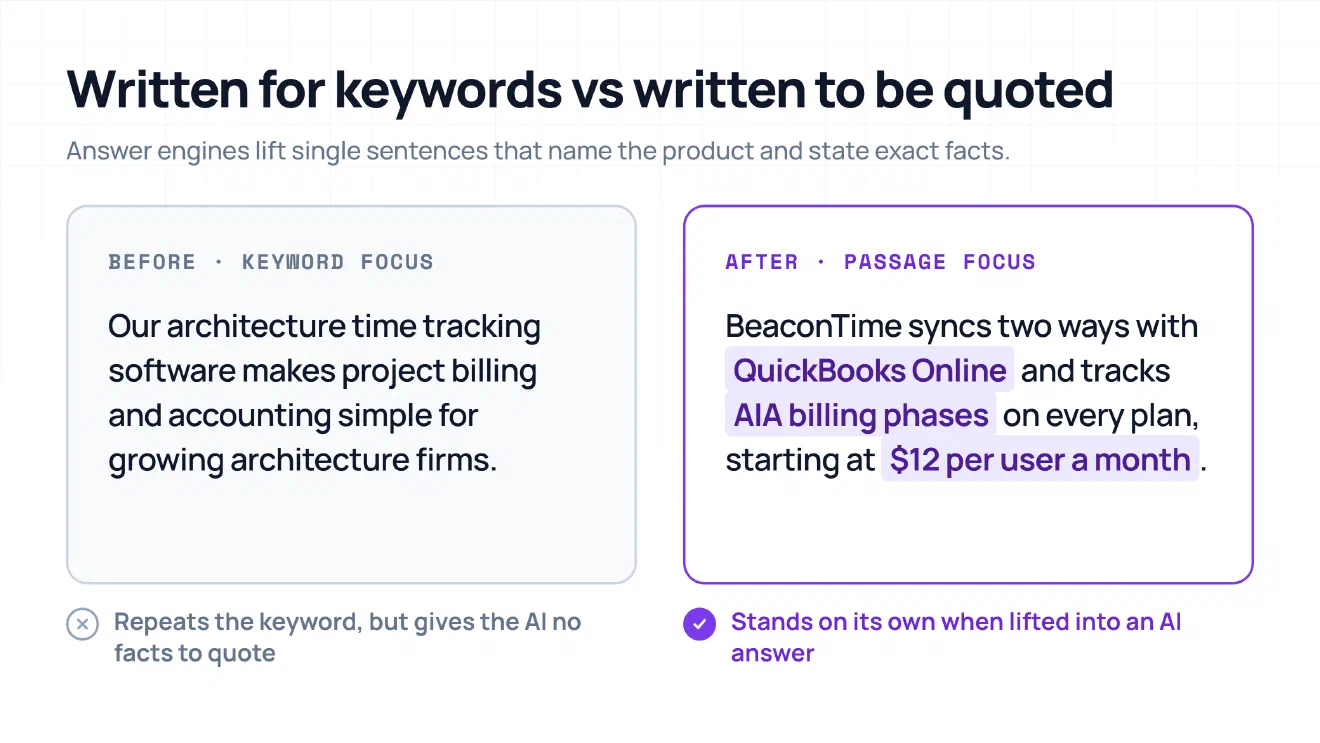
Consider how a writer might introduce BeaconTime’s QuickBooks integration for traditional keyword targeting:
Looking for the best time tracking software for architecture firms? Our architecture time tracking software is designed to make project billing and accounting simple for growing teams of all sizes.
Now consider the same point rewritten for AEO and GEO:
BeaconTime syncs approved timesheets and expenses two ways with QuickBooks Online and tracks hours by AIA billing phase on every plan, starting at $12 per user a month.
The first example repeats the keyword phrase twice, but gives an AI model no concrete facts to cite. The second sentence names BeaconTime, specifies two-way QuickBooks Online sync, mentions AIA billing phases, and states the monthly price per user. Both a buyer and an AI model receive the necessary details in a single sentence.
Keeping those facts current is equally important. When Ahrefs compared roughly 17 million URLs cited by AI assistants with standard organic results, the cited pages were 25.7% newer on average. ChatGPT showed the strongest preference for fresh content, citing pages that were an average of 458 days newer than traditional search results. Displaying a clear “last updated” date and updating numbers whenever plans change helps both search rankings and AI citations.
Why Independent Brand Mentions Matter More Than Backlinks #
Traditional SEO relies on backlinks as votes of domain authority. AI models determine credibility differently: when generating an answer, a language model extracts passages from multiple pages and looks for consensus. Your website states what you offer; independent websites confirm whether the broader industry agrees.
Data shows that AI visibility follows external consensus far more closely than domain link counts:
- In an Ahrefs study of 75,000 brands, brand mentions across the web correlated with Google AI Overview visibility at 0.664, compared to 0.218 for total backlinks. Brand mentions tracked AI visibility three times as closely as backlinks.
- In a follow-up study covering ChatGPT and Google AI Mode, brand mentions on YouTube showed the strongest correlation of any measured signal, reaching 0.740.
- In an analysis of 200,000 shopping prompts on ChatGPT by Profound, top-recommended products had a median of 787 reviews, compared to 352 for lower-ranked alternatives.
AI assistants pull those third-party mentions primarily from editorial roundups and review platforms. Across 750 ChatGPT prompts analyzed by Ahrefs, “best of” listicles accounted for 43.8% of all cited pages. Similarly, Muck Rack’s analysis of 25 million citations found that 84% came from earned editorial coverage, while only 0.3% came from paid placements.
This explains why BeaconTime can rank fourth on Google yet never appear in ChatGPT’s answers for the Chicago firm. When ChatGPT evaluates the question, it consults independent architecture software roundups and forum discussions. If those roundups omit BeaconTime or list outdated pre-QuickBooks pricing, building more domain backlinks will not fix the issue. Getting BeaconTime included in category roundups with accurate pricing and integration details provides the independent confirmation the model requires.
Measuring Keyword Rankings versus Share of Answers #
Because classic search engines and AI models operate differently, traditional reporting metrics do not reflect AI visibility.
In traditional SEO, performance relies on two primary measurements:
- Keyword rank position, tracking where a page ranks on Google (such as moving from position 7 to position 2).
- Organic sessions and clicks, recorded in Google Search Console and web analytics tools.
Neither metric applies cleanly to AI answers. Language models generate answers dynamically, meaning the exact same prompt rarely returns an identical list of brands. In a study by SparkToro and Gumshoe where volunteers ran 12 commercial prompts nearly 3,000 times, there was less than a 1 in 100 chance of receiving the exact same brand recommendations in consecutive runs.
However, when a prompt is tested repeatedly, the percentage of answers that include a specific brand remains consistent. Instead of tracking a single ranking number, GEO and AEO measure your share of answers (also called mention rate). If you test the Chicago firm’s question 50 times across a month and BeaconTime appears in 15 responses, your share of answers is 30%.
Tracking cited domains is equally important, becuase sources fluctuate frequently. In a study by Profound analyzing 80,000 prompts, roughly half of the domains cited for identical prompts changed within a single month. In tracking by Semrush across 230,000 prompts, Reddit’s share of ChatGPT citations dropped from 60% to 10% over six weeks. A single manual check does not provide an accurate baseline.
Finally, website traffic alone understates the business impact of AI recommendations. While you can measure referral visits using Google Analytics 4’s AI Assistant channel, most buyers read an AI summary and search for the recommended brand directly later. Pew Research observed that Google users click a classic search result on 8% of searches when an AI summary is present (compared to 15% without one), and click a citation link inside the summary on only 1% of visits. In GEO and AEO, being named as a recommended solution is the primary conversion event.
Comparing Traditional SEO, AEO, and GEO Side by Side #
Reviewing these five mechanisms together highlights where traditional SEO, AEO, and GEO align and where each demands different tactics:
| Comparison Area | Traditional SEO | Answer Engine Optimization (AEO) | Generative Engine Optimization (GEO) |
|---|---|---|---|
| Primary Goal | Rank in the top 10 results to earn a website click | Structure facts so an engine can extract a direct answer | Get recommended and cited in synthesized multi-source AI answers |
| Search Queries | Matches exact keyword phrases entered by users | Matches direct informational questions | Splits one complex prompt into multiple background sub-searches |
| Search Indexes | Primarily Google Search | Google, Bing, Perplexity, and voice directories | Google, Bing (for ChatGPT and Copilot), Perplexity, and Brave |
| Bot and Code Rules | Googlebot executes JavaScript and renders web apps | Clean headings and text placed high in the HTML | Allows AI search bots (OAI-SearchBot, Claude-SearchBot, PerplexityBot) and uses server-rendered HTML |
| Writing Style | Comprehensive topic coverage with repeated keywords | Direct factual answers placed right below subheadings | Self-contained sentences with exact names, figures, and dates |
| Authority Signals | Inbound backlinks pointing to your domain | Accurate facts in structured directories and databases | Brand mentions and reviews across independent roundups, videos, and forums |
| Core Metric | Keyword ranking position and organic traffic | Featured snippet ownership and direct citations | Share of answers across runs, recommendation order, and cited sources |
Why Traditional SEO Still Powers AI Answers #
Because GEO focuses on AI recommendations, it is easy to assume traditional SEO is obsolete. In practice, GEO and AEO build directly on top of your existing SEO setup.
AI models do not pull product recommendations from static training weights, which often reflect knowledge cutoffs months or years in the past. Instead, the AI conducts live web searches and reads the top candidate pages returned by the search engine. If your site has technical crawl errors, slow load times, poor indexation on Bing or Google, or thin content that fails to rank for narrow sub-queries, the AI assistant will never encounter your pages.
At the same time, you can safely avoid several common shortcuts:
- Adding an
llms.txtfile: Google representatives confirmed that AI search engines do not rely onllms.txt, and an SE Ranking analysis of 300,000 domains found no correlation between having the file and earning AI citations. - Adding custom schema markup for AI: Standard schema remains valuable for rich snippets in Google search results. However, Ahrefs found that adding custom schema had no measurable impact on AI citation frequency, and Google’s documentation notes that AI features require no unique structured data.
- Publishing mass pages for every AI variation: Creating repetitive pages to manipulate AI answers violates search engine policies against scaled content abuse. One comprehensive, factual page for each real customer need—such as BeaconTime’s QuickBooks integration guide—remains the effective approach.
What You Can Do First to Improve Your AEO #
If your team already maintains a solid SEO program, you do not need to overhaul your entire website. Begin with these five practical steps:
- Verify bot permissions. Review your
robots.txtfile and CDN firewall rules. Confirm thatOAI-SearchBot,Claude-SearchBot,PerplexityBot,Googlebot, andGoogle-Extendedcan crawl your site, and check the generative AI settings in Google Search Console. - Audit content without JavaScript. Open your pricing and key feature pages with JavaScript disabled, or inspect the raw HTML output in a terminal. Verify that plan limits, pricing figures, and integration details are present in the server-rendered HTML.
- Connect to Bing and enable IndexNow. Set up your property in Bing Webmaster Tools alongside Google Search Console, submit your sitemap, and activate IndexNow so Bing receives immediate notice when content changes. Review the AI performance reports in both platforms to see the exact queries retrieving your site.
- Rewrite key sections for standalone clarity. Review the opening 30% of your primary product and comparison pages. Replace vague marketing introductions with clear sentences that state your brand name, concrete features, and exact prices.
- Establish a share of answers baseline. Assemble 20 realistic questions prospective customers ask when evaluating tools in your space. Test each question across ChatGPT, Gemini, Perplexity, and Google AI Mode to measure how often your brand is mentioned, and record which third-party articles and videos are cited.
Manually testing 20 questions five times across four platforms requires reviewing 400 responses, which can take hours to document. Lumirank tracks your share of answers and cited sources across leading AI models automatically each day, including a free tier covering 10 prompts across two engines. Even if you automate ongoing monitoring, running your initial set of questions manually and inspecting the cited sources provides immediate insight into how AI answers evaluate your category.